Sergeant Arthur Meyerowitz's World War II career seemingly ended about as soon as it started. On only his second combat flight, Meyerowitz's bomber was shot down over France on New Year's Day 1944.
That could easily have been the end -- Meyerowitz could have perished with the plane, been shot by Germans on the ground, or captured and imprisoned for the rest of the war. But instead it was the beginning of an amazing odyssey that is told in "The Lost Airman."
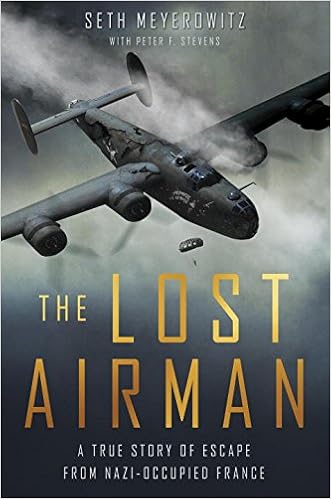
This 2016 book tells the story of how Meyerowitz parachuted successfully from the plane and was taken in by French Resistance members, who protected and hid him over five months at great personal risk to themselves. The book is written by Meyerowitz's grandson, Seth Meyerowitz, and co-writer Peter F. Stevens.
Arthur Meyerowitz was moved between various locations, and given false ID so he could "hide in plain sight." At one point, he was cast as a deaf-mute paint store worker. Later, he was a farmhand. The French then helped Meyerowitz make a dramatic escape hike through the Pyrenees mountains into Spain.
The authors occasionally move tangentially from the main story to tell of brave actions by the French Resistance members, especially a shape-shifting guerrilla leader named Marcel Taillander.
You can't help but be impressed by the gutsy actions of the French -- it's hard to believe so many people risked their lives to save a single American airman. (While by himself at first, Meyerowitz was later paired in his escape with a British officer.)
There is a wonderfully joyous scene when Meyerowitz's family learns that he is still alive.
As amazing as the story is, the writing in this book is, at best, adequate. The authors present a simplified picture of good guys versus bad guys, with the former being clever and precise, and the latter brutal and vicious. Though the story is inherently dramatic, the author's can't resist jumping in to remind us, repeatedly, that danger is everywhere. On one single page, they describe events as "nerve-racking," "unnerving," and "ominous."
In all, it's a great story, but I wish it had been told better.
----
(Please support this blog by clicking on an ad)
Tuesday, April 12, 2016
Friday, February 26, 2016
Get $100 off DirecTV
If you're signing up for DirecTV, you can get $100 back with this deal. So will I.
We both win!
Here's how it works.
1. Call (855) 822-4388 or go to http://www.directv.com/refer
2. Give account number 2328390 when signing up
That's it!
You will get $10 off your bill every month for 10 Months.
This is a member referral. You save $100, I save $100.
Wednesday, February 24, 2016
Los Angeles Times subscription phone telephone number 800-528-4637 (800-LATIMES)
Los Angeles Times main phone number 213-237-5000
Subscriber services Los Angeles Times 800-LATIMES
Los Angeles Times phone telephone number 213-237-5000
Los Angeles Times main phone number 213-237-5000
Subscriber services Los Angeles Times 800-LATIMES
Saturday, February 20, 2016
Book review: "Never Cry Wolf" by Farley Mowat
I didn't expect "Never Cry Wolf" to make me laugh so much.
The cover on the edition I read featured a serious-faced adult wolf shepherding a pup through a grass-and-rock landscape. On the back, an excerpt from a review called the book "an intimate casebook in wolf sociology." There was nothing there that shouted "funny."
Also, in my mind, I confused this book with Jack London's "Call of the Wild," a not-very-funny story of suffering, struggle and death among Alaskan sled dogs.
But "Never Cry Wolf," a 1963 book by Farley Mowat, finds plenty of room for humor.
"Never Cry Wolf" is Farley Mowat's description of his year studying wolves in the barren wilds of Canada at the behest of the government. Trappers and others living in the northern lands had claimed that bloodthirsty wolves were devastating the caribou population, so Mowat was sent to assess the situation.
Mowat finds his rigid, and sometimes clueless, government overseers to be ripe targets for sarcasm. Later, he finds that the Eskimos he encounters have difficulty fathoming his peculiar research (who boils mouse skeletons?).
There are great moments. There are the residents of Churchill, Manitowba, who find Mowat's story of heading into the wilderness to live with wolves such a ludicrous idea that they conclude he's really a CIA spy. There are the puzzled reaction of Eskimos trying to figure out why Mowat is dissecting the feces of animals. There's the image of a naked Mowat chasing wolfs through the grassy hills, alarming local natives who figured that the white man -- once again -- had lost his mind.
Observing courting and sex by a male wolf he named Albert, the author is too much of gentleman to tell all :
"My notes on the rest of this incident are fully detailed but I fear they are too technical and full of scientific terminology to deserve a place in this book. I shall therefore content myself by summing up what followed with the observation that Albert certainly knew ho to make love."
For all the humor, there are touching moments as Mowat illuminates the personalities of the wolves. They're not mindless killing beasts, he finds, a conclusion that puts him at odds with his bosses. That part is not funny.
---
(Please support this blog by clicking on an ad.)
The cover on the edition I read featured a serious-faced adult wolf shepherding a pup through a grass-and-rock landscape. On the back, an excerpt from a review called the book "an intimate casebook in wolf sociology." There was nothing there that shouted "funny."
Also, in my mind, I confused this book with Jack London's "Call of the Wild," a not-very-funny story of suffering, struggle and death among Alaskan sled dogs.
But "Never Cry Wolf," a 1963 book by Farley Mowat, finds plenty of room for humor.
"Never Cry Wolf" is Farley Mowat's description of his year studying wolves in the barren wilds of Canada at the behest of the government. Trappers and others living in the northern lands had claimed that bloodthirsty wolves were devastating the caribou population, so Mowat was sent to assess the situation.
Mowat finds his rigid, and sometimes clueless, government overseers to be ripe targets for sarcasm. Later, he finds that the Eskimos he encounters have difficulty fathoming his peculiar research (who boils mouse skeletons?).
There are great moments. There are the residents of Churchill, Manitowba, who find Mowat's story of heading into the wilderness to live with wolves such a ludicrous idea that they conclude he's really a CIA spy. There are the puzzled reaction of Eskimos trying to figure out why Mowat is dissecting the feces of animals. There's the image of a naked Mowat chasing wolfs through the grassy hills, alarming local natives who figured that the white man -- once again -- had lost his mind.
Observing courting and sex by a male wolf he named Albert, the author is too much of gentleman to tell all :
"My notes on the rest of this incident are fully detailed but I fear they are too technical and full of scientific terminology to deserve a place in this book. I shall therefore content myself by summing up what followed with the observation that Albert certainly knew ho to make love."
For all the humor, there are touching moments as Mowat illuminates the personalities of the wolves. They're not mindless killing beasts, he finds, a conclusion that puts him at odds with his bosses. That part is not funny.
---
(Please support this blog by clicking on an ad.)
Tuesday, February 9, 2016
Book review: "The Wimpy Kid Moive Diary" by Jeff Kinney
Let's not blow this out of proportion, but "The Wimpy Kid Movie Diary" is pretty good.This book shows how the movie "Diary of a Wimpy Kid" was made, using a mixture of pictures, drawings and text.
I'm not saying this is great literature, but it's fun to read and you do learn some things about how movies are made. For instance, remember the gross, moldy cheese that lies on the playground in the movie and is the focus of the dreaded "cheese touch"? The filmmakers put a lot of effort to make sure that cheese looked properly gross and moldy.
There's good stuff about how the clothing ("costumes") were chosen to reflect each characters personality and how they used a few computer tricks to do certain shots.
There is a "cheerleader" element to this book. You're not going to learn any dirt about arguments or temper tantrums on the set. They want you to like the movie, the actors and the crew.
Still, it's an enjoyable book and the blending of the pictures and cartoons with the text is nicely done.
Monday, February 8, 2016
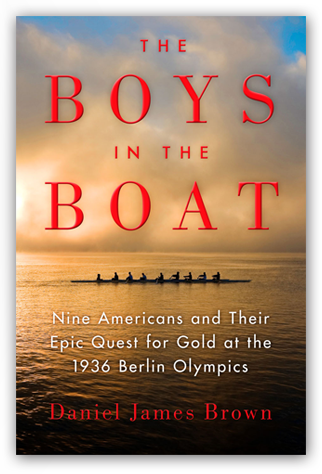
Book review: "The Boys in the Boat" by Daniel James Brown
There are a lot of good things about "The Boys in the Boat," the 2014 book by Daniel James Brown. In fact, there may be too many good things.
In this book, Brown brings alive the story of how nine American college boys from humble backgrounds ascended to to top of the U.S. rowing world and into the 1936 Olympics in Berlin.
Brown has a terrific eye for detail and his writing can be so vivid you would swear that he must have been an eyewitness to the events he's describing (he wasn't).
He describes female college students "wearing flower skirts and ankle socks" while "the first violet-green swallows of the year swirled among the spires of the library." For a young man working on a new dam, "sharp chips and shards of rock flew up and stung his face" while "sweat dripped from his back." Watching a race, a coach "sat alone in silence, methodically chewing a piece of gum, looking out intently from under the brim of his white cloth cap."
Still, for all of Brown's descriptive strength, there seems to be no storyline, no matter how tangentially related the main plot, that he can resist telling.
While this is purportedly a book about the sport of crew, there's a lot more in it: Brown tells us about Hitler's obsession with making the 1936 Olympics a showcase for German superiority, He explains the relationship between German filmmaker Leni Riefinstahl and Nazi propaganda minister Joseph Goebbels.
He talks about the building of the Grand Coulee dam, the Great Depression, and the Dust Bowl on the Great Plains. He explains the hardships of life in the Pacific Northwest in the 1920s and 30s. Mostly, the book is the life story of Joe Rantz, one of the rowers, and it is a story that involves a lot more than crew.
In fact, even if you took all the rowing portions out of "The Boys in the Boat," you would still have a pretty substantial book.
I'm almost a perfect target for this book -- like these young men, I grew up in the Pacific Northwest and I rowed at the University of Washington. I am familiar with many of places and the names in the book. Yet, even I got tired of Brown's frequent sidetrips onto other topics, no matter how interesting.
Rather than zipping through the water like rowing shell, this book meanders like a canoe on a lazy river.
That said, for those of us familiar with collegiate rowing, this has got to be the best crew book ever (OK, how much competition is there?). It captures the incredible interplay of muscle, brains and teamwork that it takes to move a wooden rowing shell through the water at high speed. Brown helps readers understand how each of the personalities in the boat combine to form one entity.
In may seem hard to imagine today, but as Brown outlines, crew was a major sport in the 1930s. Some 80,000 fans showed up to watch major races. A thousand fans and a marching band showed up at the train station to see the crew off on road trips. Big races got national radio coverage.
I liked that the publisher inserted the photos into the appropriate place in the story, rather than stuffing them altogether in the center, like some books do. It also has a very good index.
----------
(Please support this blog by clicking on an ad.)
In this book, Brown brings alive the story of how nine American college boys from humble backgrounds ascended to to top of the U.S. rowing world and into the 1936 Olympics in Berlin.
Brown has a terrific eye for detail and his writing can be so vivid you would swear that he must have been an eyewitness to the events he's describing (he wasn't).
He describes female college students "wearing flower skirts and ankle socks" while "the first violet-green swallows of the year swirled among the spires of the library." For a young man working on a new dam, "sharp chips and shards of rock flew up and stung his face" while "sweat dripped from his back." Watching a race, a coach "sat alone in silence, methodically chewing a piece of gum, looking out intently from under the brim of his white cloth cap."
Still, for all of Brown's descriptive strength, there seems to be no storyline, no matter how tangentially related the main plot, that he can resist telling.
While this is purportedly a book about the sport of crew, there's a lot more in it: Brown tells us about Hitler's obsession with making the 1936 Olympics a showcase for German superiority, He explains the relationship between German filmmaker Leni Riefinstahl and Nazi propaganda minister Joseph Goebbels.
He talks about the building of the Grand Coulee dam, the Great Depression, and the Dust Bowl on the Great Plains. He explains the hardships of life in the Pacific Northwest in the 1920s and 30s. Mostly, the book is the life story of Joe Rantz, one of the rowers, and it is a story that involves a lot more than crew.
In fact, even if you took all the rowing portions out of "The Boys in the Boat," you would still have a pretty substantial book.
I'm almost a perfect target for this book -- like these young men, I grew up in the Pacific Northwest and I rowed at the University of Washington. I am familiar with many of places and the names in the book. Yet, even I got tired of Brown's frequent sidetrips onto other topics, no matter how interesting.
Rather than zipping through the water like rowing shell, this book meanders like a canoe on a lazy river.
That said, for those of us familiar with collegiate rowing, this has got to be the best crew book ever (OK, how much competition is there?). It captures the incredible interplay of muscle, brains and teamwork that it takes to move a wooden rowing shell through the water at high speed. Brown helps readers understand how each of the personalities in the boat combine to form one entity.
In may seem hard to imagine today, but as Brown outlines, crew was a major sport in the 1930s. Some 80,000 fans showed up to watch major races. A thousand fans and a marching band showed up at the train station to see the crew off on road trips. Big races got national radio coverage.
I liked that the publisher inserted the photos into the appropriate place in the story, rather than stuffing them altogether in the center, like some books do. It also has a very good index.
----------
(Please support this blog by clicking on an ad.)
Subscribe to:
Posts (Atom)