Wednesday, February 22, 2012

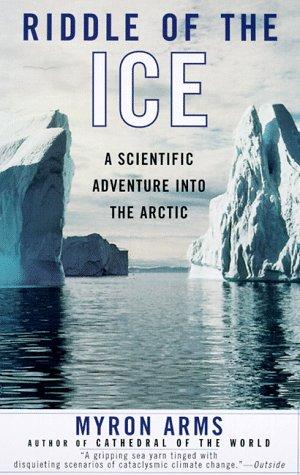
Book review: "Riddle of the Ice" by Myron Arms

It's probably not easy to get the average person interested in the science of large ice formations, so in "Riddle of the Ice" author Myron Arms tries to sneak his lectures in.

This book is built around Arms' 1994 sailing voyage along the eastern coast of Canada and the western coast of Greenland. It is, he makes clear, an enchanting region featuring spectacular glaciers and huge icebergs, and just enough storms to keep a small sailing crew on edge. But the trip seems to be only a ploy to draw you in. What Arms actually wants to talk about are the changing patterns of ice in the north Atlantic region, so he repeatedly interrupts the sailing narrative to talk about science.

Arms mean well – he wants us all to think more about the human role in global climate change – but you'd have to be really, really interested in ice to stay with his long and winding discussions of such gripping concepts as the "side channel export hypothesis," "Bond-Heinrich cycles," and the "Great Salinity Anomaly." He tries to present the topic as something of a murder mystery, but he comes to no resolution or solid conclusions other than the acknowledgment that it's a really complex subject. (Also, since I read this book 14 years after it was published, I imagine that some of the science described here has been superseded by later research.)

I did enjoy Arms' description of the sailing trip, since I wasn't familiar with the geography of this area beforehand. And Arms' contentious relationship with a young crew member named Blue, who chides the author for not being environmentally pure enough, spices up the story. But the hybrid nature of the book falls short.

If you're interested eastern Canada and Greenland, two very good books are the "The Last Gentleman Adventurer: Coming of Age in the Arctic" by Edward Beauclerk Maurice and "Two Against the Ice" by Ejnar Mikkelsen.

Monday, February 13, 2012

Movie review: "Journey 2: Mysterious Island"

If my family is any indication, "Journey 2: The Mysterious Island" is a movie that is likely to divide parents and children.

Dwayne Johnson, Josh Hutcherson and Luis Guzman


My wife and I took our kids, ages 9 and 11, to see this sequel to 2008's "Journey to the Center of the Earth" and our group came out strongly divided.

My wife and I thought the movie was pretty dreadful, hampered as it was by a clunky script, wooden acting and a predictable story.  Our kids were thrilled by the action, adventure and danger in a land of giant lizards, miniature elephants, and enormous bees that can be ridden like jetskis. They LOVED it.

In a way, we're both right – we're just watching the movie from different perspectives.

The story surrounds designated sullen teenager Sean (Josh Hutcherson), a self-centered character so obnoxious I was rooting for him to be eaten by the oversized beasts the computer graphics department spit out for the story.

At the start, Sean gets in trouble with police after breaking into a satellite facility and is grounded by his mom (Kristin Davis) and stepdad Hank (Dwayne ("The Rock") Johnson. Hank is still learning how to be a dad to Sean and somehow interprets "grounded" as "spend thousands of dollars traveling together to a mysterious island on other side of the world because Sean really, really wants to."

On the island of Palau, everyone tells them that they'll surely die before reaching the supposed site of the island since deadly storms surround the area. But once Sean sees that the story's designated cute girl (Vanessa Hudgens) will be coming along they decide to go anyway, because, after all, who wants to argue with an obstinate, horny teenager?

Once on the island, the characters face a steady drumbeat of crises while barely allowing a hair to fall out of place. To say that the story lacks plausibility is like saying that Madonna lacks virginity, so my suggestion if you do have to watch this is to just give it up and let it ride.

That's certainly how my kids approached it – little things like logic and coherence don't matter much when you have danger, teenage lust and giant electric eels on the screen.

Review: L.A. Fitness on Bellflower in Long Beach

I've been a member of L.A. Fitness for about a year, and I've had a fair chance to assess my local club (2180 N. Bellflower Blvd, Long Beach, Calif.).

Generally, this is a pretty good club. It's clean, with a nice variety of weights, cardio machines and other equipment. It has an area for stretching and abdominals. The treadmills, elliptical machines and stationary bikes all have TVs attached with a choice of 10 channels (plug in your own headphones).  It has a basketball court, swimming pool and hot tub, and some exercise classes.

All in all, there's something for everyone here. Still, if you're considering joining  there are a handful of negatives to consider:

  • It doesn't open early enough on weekends. During the week, this club opens at 5 a.m, but inexplicably stays closed on Saturdays and Sundays until 8 a.m. For those who would like to get their day started with a workout first thing, 8 a.m. doesn't cut it.  One Saturday I went by the club and found – I'm not making this up – 15 people lined up outside this L.A. Fitness at 7:35 a.m.  Clearly, the demand is there for an earlier opening.
  • Commission-oriented sales staff. Probably the most unpleasant aspect of joining L.A. Fitness is actually joining it, because you will probably have to deal with a salesperson who seems to be training for a future on a used car lot. They give you a phony smile, have you take a seat and then proceed to try to steer you into the highest priced membership they can. Ugh. One way around this is to sign up online at LaFitness.com. Even if you don't join online, you will get some sense of the prices before you enter the club.
  • Line up for spinning. Think twice if you're considering joining this club for the spinning classes. Some of these classes are so popular that people line up 45 minutes early for them (otherwise, you don't get in). You'd think that L.A. Fitness would notice this demand and add more spinning classes but I've seen no evidence of that.

For the most part, there's enough equipment that you don't have to wait to use it. Over a year, there have been three times when I've had to wait for a treadmill, and on a visit on Martin Luther King Day, my wife found that ALL the cardio machines were in use. A few times a year is not terrible, but when checking out the club it's a good idea to visit at the time of day you'd normally use it to see how crowded it is.

The televisions on the cardio machines are a nice feature, but about one out of every 10 times, I find a TV that doesn't operate right. It's an annoyance, but it's usually easy to move to a different machine.

If basketball interests you, you can find a game here. But note that the edge of the court IS the wall.  So unless you're looking for a concussion, this is no place to go diving for a ball.


---
 (Please support this blog by clicking on an ad, or by donating via the Paypal button below.)
 

Thursday, February 2, 2012

Book review: "Death and Oil" by Brad Matsen

"Death and Oil" is a crisply written account of the deadliest oil rig disaster of all time. Author Brad Matsen lays out, in careful detail, the events that destroyed the Piper Alpha oil platform off the coast of Scotland in 1988.

While it is ultimately a rather grim story – 162 men died – there are some bright spots in the stories of those men who managed to survive. Matsen makes it clear that those who survived made extra efforts to get off the rig, while those who sat and waited for rescue died.

Matsen shows a knack for including just the right details to bring the story alive. For example, he describes the aftermath of an explosion in Piper Alpha's main control room with these clear images:

"Clark had hit the wall headfirst. He was covered with blood from cuts on his face but rose to his knees through a waist-high haze of putrid smoke that filled the room. The control panels were a mess of broken glass and sparking electrical wires. Telephones and radio mikes swung on their cords. Clark looked down through the smoke and saw Bollands writhing on the floor, but the screech of metal-to-metal torment made saying anything to him impossible."

I also liked the sections on the development of offshore drilling, the history of Occidental oil and the background of Armand Hammer, Occidental's brash leader. The book has a good index - if you get confused about any of the characters or other elements, you can quickly check to find earlier references.

My one complaint about "Death and Oil" is that it is often hard to follow the workers' movements around the various tiers of the rig. The book does have one drawing showing the general layout of Piper Alpha, but one or two more detailed illustrations would have helped the reader understand references to things like the "production deck," "D Module," and the "sixty-eight" level.

Monday, January 30, 2012

Surprising lessons from Wikipedia

I set out the other day to teach my 11-year-old daughter something about Wikipedia and ended up learning a few things myself.

Wikipedia is a familiar stop for a lot of kids, including mine, when they need information for a school project or report. It's filled with just the sort of details – names, dates, places – that a student needs.

But I wanted to demonstrate to my daughter that she should use caution in using Wikipedia, since anyone can edit the material there. We came up with the idea of adding the phrase "Cheese was invented in Antarctica" to Wikipedia and seeing how long it stayed there until someone corrected it.

I opened a Wikipedia account – it's simple; you don't even need to give an email address – and proceeded to the website's entry on "Cheese." But right away, there was a problem.  When I tried to add our bogus sentence, Wikipedia told me that the cheese article is "semi-protected and can be edited only by established users."

To become an "established user," I would have to be a member for four days and make 10 edits to articles. This isn't a huge bar, clearly, but it does block someone from joining and immediately making changes to articles that are deemed important enough to have "semi-protected" status.

Not to be denied, we shifted to the Wikipedia entry on "History of Cheese." This article turned out not to be protected, so I went in, deleted one sentence, then replaced it with "Cheese was invented in Antarctica." Done.

I then told my daughter that we would check back later to see if anyone had changed our work. I fully expected that it would take hours, perhaps days, before anything happened.  But about 45 minutes later, my daughter discovered that it had already been changed back. 

What had happened?  Looking closer, I found a message from Wikipedia:

"Hello, and welcome to Wikipedia. Everyone is welcome to make constructive contributions to Wikipedia, but at least one of your recent edits, such as the one you made to History of cheese, did not appear to be constructive and has been automatically reverted (undone) by an automated computer program called ClueBot NG."

I was amazed. A computer had detected our bogus edit and stopped it. How did it know? Was the fact that I was a new user a factor?  Was the program an expert on cheese?

I'm sure it's still possible, if you're determined, to make bogus changes in Wikipedia, but it's definitely not as easy as I thought. The limitations I discovered are pretty reassuring and give greater credibility to Wikipedia.

Saturday, January 28, 2012

Book review: "Ice Bound: A Doctor's Incredible Battle For Survival at the South Pole"

This book by Jerri Nielsen slowly drew me in. By the end, it fell into the can't-put-it-down category. I really liked the descriptions of life at the South Pole (the difficulties of living there were far beyond what I imagined), and became caught up in Nielsen's battle with cancer.

There were a few things I might quibble about: Nielsen's relationship (or lack of relationship) with her ex-husband and children hangs mysteriously in the background without resolution. Clearly, there's more going on there than she explains. Also, in describing life at the station, she seems to overemphasize the parties. At times you wonder: Aren't these people there to do some work?

Still, it's a compelling story driven by colorful characters, day-to-day dramas, and the cancer and eventual rescue that you know is coming at the end.

Thursday, January 26, 2012

Capital gains tax basics


  • What is the capital gains tax? A tax on income from the sale of property, stocks, bonds and other investments.
  • When was it created? In 1913, when Congress established the income tax.
  • Who makes the most from capital gains?  About 90% of all capital gains income goes to richest 20% of Americans and about 70% goes to the richest 5%, according to the Congressional Research Service.
  • What is the current rate? The maximum capital gains tax rate now is 15%, for those in the mid- to upper-income brackets. This is the lowest rate since World War II.