Friday, March 31, 2017

Review: A visit to the Statue of Liberty

First, let me say this: the Statue of Liberty is an amazing creation to behold in person.

Second, the National Park Service is doing its best to suck the enjoyment out of visiting the statue.

A week ago, my sister and I went to see this famous landmark. This was my second visit to this statue, which rises on an island in the middle of New York Harbor. I remain in awe of the audaciousness of the whole idea.

What was creator Frédéric Auguste Bartholdi thinking?  "I'll build a 151-foot statue, intricately designed down to tiny details, and then we'll ship all 204 tons of it across the ocean to be assembled. Hope those Americans can find a spot for it!"
Enjoy your visit to the Statue of Liberty

The statue is not the only amazing part. The pedestal, constructed in 1883-84, was the biggest mass of concrete poured in the world to that time.

You get to see the wonder of the Statue of Liberty up close when you take the National Park Service-operated boats out from New York or New Jersey to Liberty Island. There's also a nice museum inside the pedestal.

Unfortunately, the experience has some sour sides.

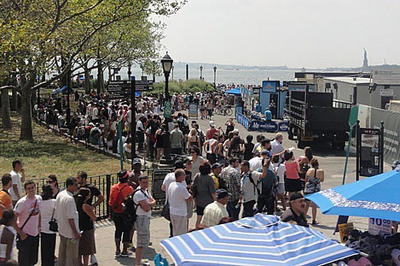
When we arrived at Battery Park at the southern end of Manhattan, we found a long, slow-moving line to get on  the boat. This was very cold Thursday in March -- not exactly the height of tourist season -- so I can imagine that the line could have been even longer.

Before getting on the boat, you have to go through an extensive security check. We removed our coats, jackets, watches, wallets, and belts and put them all in the bin to go through the X-ray machine (more than the usual airport check). It didn't go fast, but since it's all in the name of security, it's hard to complain.

But the next part was weird: Once we reached the island, and prepared to enter the statue, we faced another long line leading to another set of X-ray machines. This line moved even slower than the first one. The National Park Service labels this a "secondary security screening."

Really? What was the point of the first screening if they are just going to do it again? Are the first screeners just the interns and they miss a lot of stuff?

As it turns out, the second check isn't for security -- if you had bomb or gun or something like that it would have already been caught on the mainland. This second stop was to keep out food and backpacks.

Why can't you bring food in? I don't know.  Keep in mind that this was a ban on simply carrying food. If the point was to keep people from eating food, the NPS could simply post "no eating" signs like they do on neighboring Ellis Island. That would be simpler and less costly that manning X-ray machines.

Why can't you bring backpacks in?  I'm not sure, but money could be a factor. The NPS operates lockers where people can store their belongings for $2 while they go inside the statue. Multiply that by a million or so visitors a year, and you can see how operating those lockers could add up to a nice chunk of change for the NPS.

--

Please support this blog by clicking on an ad.


Tuesday, February 28, 2017

Racial discrimination at Swarthmore College

High school students applying for a  program offered by Swarthmore College could be rejected because of their skin color or race, application criteria indicate. 

The "Discover Swarthmore" program -- in which selected high school students are brought to the small college outside Philadelphia for a visit -- uses race as one of its selection criteria.

Program organizers say they will "prioritize" applicants who are African American, Latino, Native American, and Asian Amercan -- in other words, every race but white. Those applicants with skin color that is too light will end up on the bottom of the consideration pile.

Is this OK?  Imagine if it was a different racial group singled out. Pretend the program said: "We will prioritize applications from whites, Latinos, Native American and Asian Americans," African Americans are left out. Would that be OK? 

In 1963, Martin Luther King Jr. said, "I have a dream that my four little children will one day live in a nation where they will not be judged by the color of their skin, but by the content of their character."

Why, 54 years later, are we still judging people by the color of their skin?

===============

Here's the announcement from Swarthmore:

Discover Swarthmore (DS) Program affords students the opportunity to visit one of the best liberal arts colleges in the country, all expenses paid! The program will provide participants with a taste of the college experience, including the opportunity to meet other talented students, learn from faculty members, eat in the dining hall, and spend a few nights in residence halls with student hosts.

While the dates have not yet been set, Swarthmore is planning to offer two DS programs to give students maximum flexibility in attending one of the programs. Last year, the programs were hosted in September and October.

Nomination and Selection Criteria

Discover Swarthmore is open to all rising high school seniors, but the selection committee will prioritize applications from students with the following characteristics:
  • Traditionally underrepresented groups (African-American, Hispanic/Latino, Native American, and Asian-American)
  • First generation in their family to attend college
  • Low-income students (Pell-eligible, free/reduced lunch, etc.), and students who might not otherwise be able to afford a trip to campus
  • Rural and small town students
  • Undocumented and DACA-eligible students
Additionally, any rising seniors (U.S. citizens, Permanent Residents, and undocumented/DACA students living in the United States) interested in attending, regardless of demographic or economic background are invited to apply. Swarthmore supports diversity of all forms including, but not limited to, racial, ethnic, ideological, sexual/gender identity, geographic, and religious diversity.

Wednesday, February 1, 2017

Stop saying "seven Muslim majority countries"

Look, I get it. Donald Trump's order barring immigration from Syria, Iran, Iraq, Somalia, Sudan, Libya and Yemen is deeply flawed.

But using the shorthand to describe the targeted nations as "seven majority Muslim countries" or "seven predominantly Muslim countries" -- as many news outlets have repeatedly done -- is not only unhelpful, it's potentially dangerous.

First, choosing to describe these countries by their dominant religion suggests that they are unique in being heavily Muslim. That's not true. There are 49 countries with a Muslim majority population

Do we describe the North America Free Trade Association as involving "three Christian majority countries." Would that be helpful?

Further, these thumbnail descriptions suggest that the countries were selected because they're majority Muslim. That's not true, either. They were selected because the Trump administration -- rightly or wrongly -- believes they are a major source of terrorists. If Trump was out to target Muslim countries with this order, there are much larger targets. In fact, out of the 10 countries with the most Muslims, only one (Iran) is on the list.

The worst part of this is that by emphasizing the religion of the barred countries the media is fanning the flames of a wider religious conflict. I don't blame the people from these seven countries for being upset, but turning this into a Christian vs. Muslim issue is inflammatory and could lead to bloodshed.

How else can news stories refer to these countries?

They could simply say "seven countries," and then list the countries in later on. You could say "seven countries in northern Africa and the Middle East," although with the same number of words you could just list the countries.

You could say "seven countries that the Trump administration believe incubate terrorism." That's a little wordy, but at least specific and accurate.

At the very least, all stories should list the countries. I've seen several stories that say "seven majority Muslim countries" or "seven predominantly Muslim countries," but never say what the countries are. That's poor journalism.

Or here's a crazy way of doing it. Just list the countries.  Consider a story from CNN that says this:

"Trump's executive order on immigration bars citizens of seven Muslim-majority countries from entering the United States for the next 90 days and suspends the admission of all refugees for 120 days."

Instead, just say this:


"Trump's executive order on immigration bars citizens of Syria, Iran, Iraq, Somalia, Sudan, Libya and Yemen from entering the United States for the next 90 days and suspends the admission of all refugees for 120 days."


That works, is specific, and is useful for the reader.


Saturday, January 28, 2017

Book review: "Best. State. Ever." by Dave Barry

It pains Dave Barry to say it, but say it he must:

"Florida has become The Joke State, the state everybody makes fun of."

As Barry figures it, Florida's joke status started with the 2000 presidential election when the state couldn't figure out who it voted for, launching a month of intensive news coverage of the state.

"This coverage did not present a positive image of Florida," he notes. "It featured endlessly replayed videos of deeply confused Florida election officials squinting at Florida ballots that were apparently designed by dyslexic lemurs and then turned over to deeply confused Florida voters, many of whom apparently voted for nobody for president, or voted for two presidents, or used the ballots to dislodge pieces of brisket from between their teeth."

From then, coverage of Florida progressed through an endless parade of weird news stories, like the shark that died in a highway accident, or the man who died in a cockroach-eating contest.

Dave Barry's heard them all, and as professional humorist who lives in Miami, he appreciates the good laugh. But he wonders: Do people really know Florida?

In "Best. State. Ever. A Florida Man Defends His Homeland," Barry takes us on a tour of all that is weird and wonderful about the state. As always, Barry is funny, but he also manages to go a little deeper.

Barry takes us to a variety of Florida attractions, such as the mermaids at Weeki Wachee Springs;  the alligators at Gatorland (aka "Orlando's Best Half-Day Attraction") and the chaotic bacchanal of Key West.

He.talks to the quirky characters that give Florida its, well, character, such as Dave Shealy, the operator of something called the Skunk Ape Research Headquarters. He draws people to his campground in the Everglades with stories of a mysterious "ape" that roams the swamps.

Barry acknowledges the strangeness of it all, but at the same time embraces it. The book offers a fond look at the state, along with plenty of laughs.

----

(Please support this blog by clicking on ad.)

Tuesday, January 17, 2017

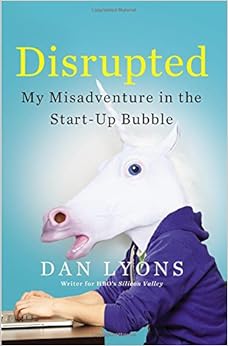
Book review: "Disrupted: My Misadventure in the Start-Up Bubble"

Dan Lyons was 52, with a wife and kids to support, and suddenly needed a job.

Lyons had recently been laid off as technology editor at Newsweek in 2012. He could have sought another job in journalism, but that field was imploding. Besides, he was intrigued with the world of high-tech start-ups. He'd interviewed many people at such companies as a journalist, and even though many of them didn't seem that bright, everyone was getting rich.

He wanted a piece of it.

So Lyons accepted a job with a 5-year-old Boston company called HubSpot as a "marketing fellow." Thus began Lyons' strange odyssey that he describes in his 2016 book, "Disrupted: My Misadventure in the Start-Up Bubble."  It's a book that, at turns, is funny, disturbing and sad.

Lyons had high hopes for his new job, but from day one -- literally -- things go awry. When he arrives for work, neither of the managers that hired him are there to welcome him and no one quite knows what to do with him. He is startled to discover that a 26-year-old who he first assumed was an administrative assistant is actually his new boss.

The average age of a Hubspot employee, Lyons learns, is 26, and he is twice that. It is a workplace designed for the young. The company stocks the cafeteria with snacks, beer and a "candy wall" -- all free. There's a foosball table, ping-pong table, indoor shuffleboard, and a set of musical instruments, "in case people want to have an impromptu jam session." Some employees work while sitting on large rubber balls; conference rooms have beanbag chairs.

Lyons struggles to fit it, but he never does. He's the "old guy" in the office and at any rate, age is only one of the things that set HubSpot apart. There is a forced perkiness in the work culture -- the "HubSpotty" way of doing things  and its own HubSpeak  When someone quits or is fired, it is called "graduation."

"HubSpotters talk about 'inspiring people,' 'being remarkable,' 'conquering fear,' and being 'rock stars' and 'superstars with super powers' whose mission is to "inspire people" and 'be leaders,'" Lyons writes. "They talk about engaging in delightion, which is a made-up word, invented by Dharmesh (a company co-founder), that means delighting our customers. They say all of these things without a hint of irony."

And: "They use the word awesome incessantly, usually to describe themselves or each other. That's awesome! You're awesome! No you're awesome for saying I'm awesome.
  
"They pepper their communication with exclamation points, often in clusters, like this!!! They are constantly sending around emails praising someone who is totally crushing it and doing something awesome and being a total team player!!! These emails are cc'd to everyone in the department. The protocol seems to be for every recipient to issue his or her own reply-to-all email joining in on the cheer, writing things like 'You go,girl!!' and 'Go HubSpot, go!!!!' and 'Ashley for president!!!'"

To Lyons, it seems a lot like a cult.  His unease deepens whern he realizes that HubSpot -- for all its talk about "being remarkable" -- is in the unremarkable business of helping companies send out spam email. Billions and billions of spam emails. Except they call it "lovable marketing content."

A key question in the book is whether HubSpot is a uniquely bizarre company, or whether it is representative of other start-up tech companies. Lyons offers mixed evidence. Yes, there are some cases where HubSpot seems way outside the norm -- on Halloween, everyone dresses up in costume -- but in other areas, such as a preference for young, cheap employees, it seems to fit with others start-ups.

In some ways, Lyons' difficulty in fitting in with HubSpot is due less to the company being a start-up than the fact that it is marketing and sales. This is far from the journalism that Lyons was used to.

Lyons did, in some cases, contribute some of his work problems. When a top executive asks him to assess the company's blog, Lyons responds with a detailed email critical of the blog and, by implication, the people who run it. Guess what? The email is forwarded to the people who run the blog and they turn cold on Lyons.

(A good rule for any workplace: If you are going to criticize someone, don't put it in writing.)

There are larger issues that come to mind in reading "Disrupted": ageism in the workplace, the house-of-cards nature of the whole start-up world, and why we put so much of our personal information in the hands of such ditzy companies.

Still, what I enjoyed most about "Disrupted" is that it gives you an inside look at another workplace. Most of us, buried in our own jobs, have little idea how different the culture can be elsewhere.

Lyons puts you there,  as if you yourself were suddenly working at HubSpot. As Lyons went through this experience, I felt like I was there with him, feeling the confusion, the amusement, and the pain.

-----

(Please support this blog by clicking on an ad.)

Friday, January 6, 2017

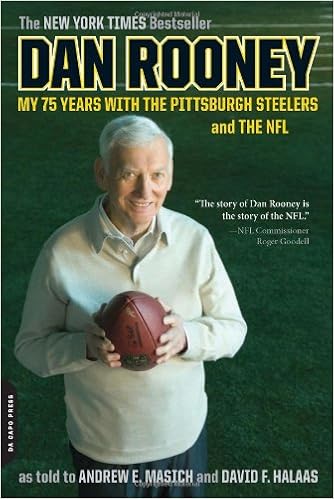
Book review: "Dan Rooney - My 75 Years With the Pittsburgh Steelers and the NFL"

By the time the 1955 National Football League draft reached its ninth round, all the big college stars had been taken. But 23-year-old Dan Rooney, who was helping make draft selections for the Pittsburgh Steelers, saw potential in a skinny quarterback out of the University of Louisville named Johnny Unitas.

"We gotta get this guy now because we don't want him playing against us," Rooneysaid.

Following Rooney's advice, the Steelers drafted Unitas, who would become one of the greatest quarterbacks in NFL history. But he never played at all for the Steelers.

Steelers coach Walter Kiesling thought Unitas was "too dumb to play" in the NFL, Rooney recalls in his autobiography, "Dan Rooney - My 75 Years With the Pittsburgh Steelers and the NFL."

Kiesling never gave Unitas a chance in training camp and cut him before the season started. A year later, Unitas signed with the Baltimore Colts and began a stellar career in which he was named the NFL's Most Valuable Player four times.

This is one of many anecdotes Rooney tells in this enjoyable book. While not perfect, the book has enough going for it to qualify as a must-read for hardcore Steeler fans and a good choice for anyone with a interest in the history of the NFL or the City of Pittsburgh.

Rooney has a unique position in the NFL. He has spent virtually his entirely life immersed in professional football. His father, Art Rooney, was the original owner of the Steelers, and Dan Rooney started early working with and helping manage the team. Dan became president of the team in 1975 and took over the organization after his father died in 1988.

"Football is in my blood," he said.

Rooney describes his early years growing up in Pittsburgh, becoming a high school football star  while simultaneously working in the Steelers organization. At that time, the National Football League was a minor sport that struggled to attract players, let alone fans. During World War II, Rooney recalls, there were so few available men to play that the Steelers temporarily merged with the St. Louis Cardinals, becoming the unfortunately named "Card-Pitts."

Professional football grew in fits and spurts, but the Steelers were rarely successful on the field. One of the big problems was that his father simply hired his friends as coaches. Another problem, Dan Rooney says, is that his father was more of a baseball fan than a football fan. Yes, the owner of the Pittsburgh Steelers preferred to watch baseball.


The book is filled with fond, warm memories. Rooney doesn't dwell on the negative, and sometimes glosses over issues when you wish he would tell you more.  He tells stories about his family, crashing his private plane, the NFL's compromise selection of Pete Rozelle as commissioner, the merger with AFL and personal clashes with Oakland Raiders owner Al Davis.

He wanders occasionally off track to tell us the biographies of players, which we could get anywhere. The book is best when he tells his personal story.  The book has two co-authors, Andrew E. Masich and David F. Halaas, so it's hard to say how much of the writing was actually done by Rooney.

If you like stories on old-time football, here are two other books you might enjoy: "That First Season" by John Eisenberg, the story of Vince Lombardi's first year coaching the Green Bay Packers, and "Instant Replay,", Jerry Kramer's diary of the Packers 1967 championship season.
------------

(Please support this blog by clicking on an ad.)


Friday, December 16, 2016

Dear Los Angeles Metro: The Blue Line is ill

(I sent this to Los Angeles Metro on Dec. 16, 2016)

Dear Metro:

I've been riding the Blue Line for some 18 years, so I know its moods pretty well. And it's become quite apparent in the last few months that the Blue Line is just not itself.

The Blue Line has reliably delivered me from Wardlow Station to 7th Street/Metro Station -- and back again --  thousands of times. But lately it has developed a bad case of the "waits."

Nearly every day now, riders on the Blue Line experience repeated stops and delays -- maybe two minutes, maybe five minutes, even 10 minutes or more.

To determine just how sick the Blue is, I took its temperature. For 10 days I timed every ride I made on the Blue Line (20 rides in all). This is a ride that should take 42 minutes. That's not my opinion; that's what Metro's own timetable says. And for 18 years, the Blue Line has had little trouble meeting that time.

Today, however, something is clearly wrong. Out of all the rides I timed, the Blue Line was able to complete the Wardlow-Metro Center run (either way) in 42 minutes only 35% of the time.

Here's the complete record:


  • Nov. 28, a.m.: 44 minutes, 2 minutes over
  • Nov. 28, p.m.: 49 minutes, 7 minutes over 
  • Nov 29, a.m.:  53 minutes, 11 minutes over
  • Nov. 29, p.m.: 53 minutes, 11 minutes over
  • Nov. 30, a.m.: 42 minutes, On Time
  • Nov. 30, p.m., 48 minutes, 6 minutes over
  • Dec 1, a.m.: 48 minutes, 6 minutes over,
  • Dec. 1, p.m.: 44 minutes, 2 minutes over
  • Dec 2, a.m.: 41 minutes, 1 minute under
  • Dec. 2, p.m. 42 minutes,  On Time
  • Dec 5, a.m.: 49 minutes, 7 minutes over
  • Dec. 5, p.m. 42 minutes,  On Time
  • Dec 6. a.m.: 42 minutes, On Time
  • Dec. 6, p.m.: 42 minutes,  On Time
  • Dec 7, a.m.:  51 minutes, 9 minutes over,
  • Dec. 7, a.m.: 46 minutes, 4 minutes over
  • Dec. 12, a.m.: 51 minutes, 9 minutes over
  • Dec. 12: p.m.: 40 minutes, 2 minutes under
  • Dec 13, a.m.: 49 minutes, 7 minutes over
  • Dec. 13, p.m. 43 minutes, 1 minute over
(Note: I did not ride the train on Dec. 8 or 9)

Anyone -- or any train line -- can have a bad day, and Blue Line passengers understand that. But what's alarming here is that these delays happen virtually every day. Would you fly an airline that has just a 35% on-time record?  Would you buy milk if it was sour 65% of the time?

This is not just a matter of annoyance. This is a breach of contract. Metro is not giving riders what they are paying for. Metro is exposing itself to a class action lawsuit.

The good news is that the record shows that Metro can do this right. In fact, two of the rides in my study came in under 42 minutes. 

Is Metro going to fix this? Or will Metro admit that it can't and just change its timetables?