Saturday, February 27, 2021

Book review: "Cry, the Beloved Country" by Alan Patton

 It took me a long time to read "Cry, the Beloved Country." Decades, really.

That's how long the book sat on the shelf at my house. It was one of those books that I thought I would get to someday.

That day finally came this year, and I pulled it off the shelf. I figured I'd already taken too long to get to a book that is often considered the classic novel of South Africa.

But even with the book in my hands, it took a while to get started. The paperback version I had began with a  three-page "Note on the 1987 Edition," followed by a one-page "Note on the 1959 Edition." That was followed by "Note on the 1948 Edition" (another three pages) and then the foreword, and then an 11-page introduction.  Then, finally, came the book - whew!

So was it worth the wait? "Cry, the Beloved Country" is quite good, though imperfect. I would recommend it for anyone with an interest in South Africa.

I was impressed by how author Alan Patton used a personal story focusing on an aging pastor to illustrate the culture and conditions of South Africa of the 1940s. Perhaps not surprising — since blacks and whites in South Africa at the time lived much different lives — racial issues are a large part of the story. 

The book engages you from the start as main character Stephen Kamalo, receives a letter prompting him to abruptly leave his small village and head to the massive city of Johannesburg, a place he initially finds bewildering. Kamalo is on hunt for, first, his sister, and then his son, both of whom vanished into the amorphous metropolis after leaving the village. 

The hunt keeps the story moving forward, but when it ends, only midway through the book, the story loses much of its impetus. Patton, a South African, clearly wants to show the racial tensions in the country, but seems unsure how to best do so. There are some passages in the midsection of the book, seemingly unfinished, where it's hard to tell whose perspective is being presented. The character of Kumalo's brother rises to some significance in this portion, then disappears from the narrative.

The book regains it's footing in the last third, and finishes strong. An emotional scene between Kamalo and his condemned son had me close to tears.  

The book, and much of the dialog, is written in something of a stilted, old-fashioned format.

"I have come," he said.

"It is good."

"You did not write."

"No, I did not write."

"Where is your husband?"

"I have not found him, my brother."

Taken out of context, the passage seems almost cartoonish. But it works in "Cry, the Beloved Country," because Patton uses it consistently and the rhythm fits with the story.

I did find it strange that there are some characters with continuing roles through the book —"the girl," "the boy," "the young white man" — whose names you never learn. 

Once I finished, I returned to the start of the book and read the notes and foreword. It was interesting to find that the book wasn't even written in South Africa, but in Norway and San Francisco. (Patton was traveling at the time.)

Even more interesting was that the book came to be published largely because of the determined efforts of two friends Patton had in California. They liked the story so much, they queried publishers on Patton's behalf.  When one expressed interest, then spent a frantic few days turning the author's handwritten manuscript into a typed version that barely reached New York in time for a fateful meeting between Patton and the Scribner publishing house. 


Friday, January 29, 2021

Review: "60 days in Pinal County Jail"

I don't know about you, but every time I see a show about the harsh and violent world inside prison, I wonder: "How would I do in jail?" I've never been behind bars, have little-to-no "street smarts," and the last time I was in a fight was 6th grade. Would I be an instant target?  Would I become someone's "bitch"?

So when I saw "60 days in Pinal County Jail" pop up as suggested viewing on Netflix, I thought this  might be my chance to get a realistic picture of life in jail (or, at least, this particular jail).

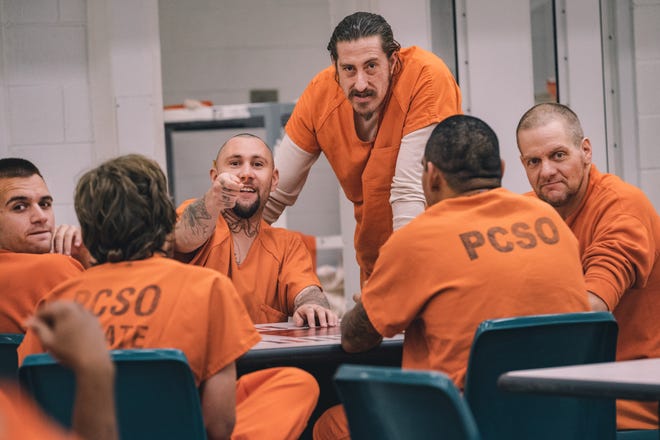
Pinal County jail inmates

In this show, seven "regular" people are sent undercover as inmates into this Arizona jail. Only the sheriff and a handful of other top officials are aware of their true identities. Each participant is given a "mission" to see what he or she can learn on one of three topics: Drug use, gangs, or "jailhouse operations."

The idea, according to Sheriff Mark Lamb, is to help him learn what is really going on in the jail. But let's face it: What we really want to see is whether the incoming "sheep" will by eaten alive by the prison's wolves.

I was particularly drawn to a slightly pudgy participant named Mark. The sheriff called him "soft" at the start and Mark admitted to being scared. Hey, I thought, that's me! 

"60 Days in Pinal County Jail" goes to some lengths to portray the jail as dangerous. At every opportunity, the show flashes a montage of violent shots (inmates fighting, someone screaming, guards forcibly holding down a prisoner). To emphasize the point, the sheriff and his aides repeatedly state that the subjects are risking their lives.

But once you get past all the bluster, and watch as the cast members enter the jail and settle into daily life, well, not that much happens. While the series stretches to 11 episodes, there's probably only enough good material for seven or eight. 

To gin up some tension, the show has to make the most of some pretty tepid disputes — a stolen can of soda, a TV that's too loud, or Mark's missed chance to sign up for a razor for shaving.  

One thing this show has is swagger, and no shortage of it. The inmates, both men and women, have no problem talking tough. If you played a drinking game where you took a shot every time one of the inmates promised to hurt someone, you'd be shitfaced in no time.

But if you could only drink when an actual punch was thrown, well, you could easily get in your car and drive through a DUI checkpoint after most of the shows. 

There are a few fights, but only between people who choose to fight (the male prisoners have a particular room designated for fighting). The scariest guy on the show actually turns out to be one of the participants, an ex-convict turned chaplain named Abner.

Abner seems to take his play-acting a little too seriously, quickly rising to the number two in the Chicano group in his jail pod, a spot he repeatedly tells us is "The Enforcer." Somewhere along the line he forgets that he supposed to be watching for trouble and not causing it. 

"I lost myself in there," he admits later, adding, "I actually was a gang member in there."

Abner repeatedly stirs up the racial tension in the pod. In one of the most bizarre turns, Abner singles out a a young inmate who is trying to avoid the racial politics, punches him, and then goads another prisoner into landing a few more blows on the youth (who does not fight back). 

Abner isn't the only one of the "cast" (that's what the show calls them) who behaves strangely One of them, a private investigator named Steve who brags ahead of time about how tough he is, causes problems almost the minute he enters the pod. He inexplicably gives the "emergency" extraction single in a non-emergency situation ("I just wanted to see if it would work," he says in the epilog). He then threatens to expose the whole program to the inmates. He is quickly yanked and sent home. 

The three women, Brooke, Vivian and Jasmyn, are explicitly told ahead of time to work independently and not to congregate together. As soon as they enter the jail, they congregate together. 

I liked another participant, a cop named David, who was tough, smart and often the voice of reason in defusing tensions between inmates. But he made two reckless mistakes late in show, revealing a connection to Abner and then confessing his undercover role to one of the guards. This triggers a cascade of events that causes the entire program to be cut short. 

As it turns out, the participant who did the best was "soft" Mark. He stays close enough to the action to have a good view, without finding himself in too deep. Other than Steve (who barely had time to ruffle his sheets before being pulled), Mark is the only participant who didn't drawn suspicion as a snitch.


Wednesday, January 20, 2021

Book review: "The Answer is ..." by Alex Trebek

It's not really surprising that I would like Alex Trebek's autobiography. After all, I have long been a big fan of "Jeopardy," the quiz show that Trebek hosted for 37 years before his death from cancer in November 2020.

What surprised me about "The Answer is ..." was that not only did I like the book, it made me like Alex Trebek even more than I had.

In the book, Trebek acknowledges that he has long been viewed as "aloof." Of course, it's hard to really know someone through the prism of television, but while I respected him as host of "Jeopardy," I shared the sense that Trebek saw himself a bit above the rest of us.

But in "The Answer Is ...," Alex Trebek reveals a more human side. He describes himself as both "reserved" and "silly." He worries that he is sometimes oversensitive to criticism. He gets frustrated, like we all do, when he calls his bank and can't reach a person.

Trebek emphasizes that he has always tried to keep the focus of "Jeopardy" on the players rather than himself (he insisted on being called the "host," not  the "star," of the show).  

"You could replace me as the host of the show with anybody and it would likely be just as popular," he writes.

It turns out that Trebek is in many ways a modest and down-to-earth guy who loves simple things like crossword puzzles and home fix-it projects. This is a man — a millionaire many times over — who opted to fix his own dryer rather than pay a repairman $200. Why? He loves a challenge.

"That's very important in life. It's one thing to do the same thing well over and over again," he notes. "But try to force yourself into attacking a new project that you've never done before, and say, 'Okay, how do I solve this?'" 

The format of "The Answer Is ..." is unconventional for an autobiography. Rather than a wall-to-wall life story, Trebek offers short vignettes from his life and small selections of thoughts. Most of the chapters are just two or three pages long; he tells a quick story or offers few thoughts, and then ends it. For the most part, it works. I might try it myself if I ever write an autobiography. 

 Among the various things, we learn:

  • His actual name is George Alexander Trebek
  • He spent less than two days in military college before quitting
  • A third grade prize he received for public speaking propelled him to seek a career in broadcasting
  • At an event he was hosting in 1967, he met Queen Elizabeth II and they chatted for a surprisingly long five minutes. The next day, when he saw her again, she didn't remember him. 
  • Worried that he was too clean-cut, he started joking about having a drinking problem (in fact, he preferred 1% milk)
  • He had a habit of arriving 10 minutes early for everything. 
There are a few gaps. For example, I would have liked to hear about the trips he made as part of the show — to the Galapagos Islands, Machu Picchu, and the Dead Sea, among others — but he doesn't talk about them.

Also, the book includes three photos of him in costumes from the New York Metropolitan Opera. This deserves at least a short explanation, but it's not there.

What is there are honest thoughts about the value of family, and hard looks at the debilitating effects of pancreatic cancer. 

"One taping day early in my treatment, my stomach cramps got so bad that I was on the floor writhing in pain," he writes. He still did the show that day.

"Aloof" or not, Alex Trebek had a classy final act. He wrote the book knowing that it would likely be his last opportunity to describe his outlook on life.

“My life has been a quest for knowledge and understanding, and I’m nowhere near having achieved that," he reflects. "And it doesn’t bother me in the least. I will die without having come up with the answer to many things in life."

He adds: "I'd like to be remembered first of all as a good and loving husband and father, and also as a decent man who did his best to help people perform at their best. Because that was my job."


Friday, January 8, 2021

Book review: "Answers in the Form of Questions" by Claire McNear

It would have been easy for Claire McNear to have written a half-ass book about "Jeopardy." Plenty has been written about the long-running TV quiz show in magazines, newspapers and books, and there have been multiple "behind the scenes" short documentaries and videos. 

McNear could have easily taken pieces from all these sources, cobbled together something resembling a book and sent it off to the publisher without breaking a sweat.

Fortunately for all of us, McNear is not a half-ass journalist. For "Answers in the Form of Questions," she went all out  interviewing every significant person involved in the making of the show, as well as notable and not-so-notable contestants and devoted fans.  She goes back stage to watch tapings, spends a night playing bar trivia alongside some of the show's past champions, and visits quiz competitions to see "Jeopardy" wannabes in training.

"Many fans are surprised to learn just how sportlike 'Jeopardy' can be," McNear writes. "It has many of the hallmarks that we associate with sports: a prospect pipeline, rigorous physical (and, yes, mental) preparation, a hall of fame, and strategic innovators revered decades later for their additions to the game, who sometimes go on to assume the role of coaches."

 "Answers in the Form of Questions" is a terrific book that both serious and casual "Jeopardy" fans will enjoy. McNear details the history of the show, the background of host Alex Trebek, the testing and audition process for would-be contestants, the mysteries of the writers room, and the curious subculture of "Jeopardy" fanatics. 

Even if you think you know a lot about the show you'll learn something in this book. Did you know that John McCain, the future senator and presidential candidate, was a one-day winner in 1965? That you can't wager $69 or $666 on the show?  That Alex Trebek actually hosted "Wheel of Fortune" before "Jeopardy"?

I learned that before the Final Jeopardy portion, show staff have players write "Who is" or "What is" on their video screen so they don't forget during the critical 30-second countdown. I didn't know that there's a "Jeopardy" bar scene the evening after taping, since many contestants stay in the same hotel. I had never heard of notorious contestant Barbara Lowe, who appeared on "Jeopardy" and other shows using fake names. 

"Answers in the Form of Questions" digs into game strategy tips shared by former players, including wagering tactics, and the importance of knowing how to use the buzzer (or "signaling device," as the show calls it).  You may never have heard about the "enable light," but after you read this book you'll know there is a raging debate in the "Jeopardy" community about whether or not to use if for buzzer timing.

One thing the book is not about is the Alex Trebek's battle with pancreatic cancer, which led to his death in November 2020. McNear only spends a few paragraphs on it, including noting that original "Jeopardy" host Art Fleming also died of pancreatic cancer. If you want more about Trebek, consider reading the book he released before hid death, "The Answer is..."


Thursday, November 26, 2020

Deonte Murray's criminal history

Deonte Lee Murray, born June 2, 1984, was arrested in September 2020 and charged with shooting two Los Angeles County sheriff's deputies. 

Here is Murray's criminal case history based on records from Los Angeles Superior Court. Note that in cases where a defendant is sentenced to jail, court records do not indicate how long the person spent incarcerated.

Aug. 19, 2002 (age 18): Murray pleads no contest to car theft and is sentenced to five days in Los Angeles County jail, 10 days of community service and 26 months of "summary probation" (this is also known as "informal" probation and does not require supervision by a probation officer). 

April 25, 2003 (age 18): Murray is charged with possession of methamphetamines with the intent to sell. He pleads no contest. The next month he is sentenced to 120 days in L.A. County Jail and formal probation for three years.

Jan. 12, 2004 (age 19): He is charged with petty theft. He pleads not guilty. The charges are later dismissed without a trial.

Feb. 10, 2006 (age 21): Murray is charged with transporting or selling marijuana, possession of marijuana, and possession of a gun while committing a "street gang crime." The possession charge is dismissed while he pleads no contest to the other two. He is sentenced to two years in state prison for each of the two convictions.

Dec. 27, 2007 (age 23): He is charged with being a felon in possession of a gun and pleads no contest. A charge of "obliteration of identification marks" on a firearm is dismissed. He is sentenced to two years in prison.

Jan. 26, 2010 (age 25): Murray is charged with receiving stolen property, later pleads no contest, and is sentenced to two years in prison. He pleads not guilty to a charge of "petty theft with a prior." That charge is dismissed.

June 28, 2011 (age 27): He is charged with possession of methamphetamine, pleads no contest and is sentenced to one year of formal probation. 

Sept. 11, 2011 (age 27): Murray is charged with receiving stolen property, later pleads no contest and is sentenced to two years in prison. Two other charges of burglary and possession of burglary tools with criminal intent are dismissed.

March 5, 2013 (age 28): Online court records show that a criminal case was filed in Los Angeles' Central Arraignment Courthouse on this date against Murray for a "violation" on Oct. 30, 2012. But the record indicates only two court proceedings in the case and no charges or sentencing details are shown.

July 11, 2013 (age 29): Murray is charged with possession of methamphetamine. He pleads no contest and is sentenced to 16 months in county jail. 

July 26, 2013 (age 29): Online court records show that a criminal case was filed in Central Arraignment Courthouse on this date against Murray for a "violation" on July 17, 2013. But the record indicates only two court proceedings in the case and says "There are no charges for this case."

Aug. 16, 2013 (age 29): He is charged with four crimes on this date. Two counts of robbery and one of burglary are ultimately dismissed, but he pleads guilty to a different burglary charge. He is sentenced to 40 months in county jail.

Aug. 23, 2013 (age 29): Online court records show that a criminal case was filed in Central Arraignment Courthouse on this date against Murray for a "violation" on June 23, 2013. But the record says "There are no charges for this case" and offers no further details. 

June 10, 2015 (age 31): Murray is charged with domestic violence. He pleads no contest and is sentenced to 60 days in county jail.

July 20, 2015 (age 31): Murray is charged with three crimes from a "violation" eight days earlier. He pleads not guilty to one count of domestic violence that is ultimately dismissed. He pleads no contest to charges of making criminal threats and disobeying a court order and is sentenced to 180 days in jail for each charge, plus five years of formal probation.

Oct. 26, 2016 (age 32): He is charged with being a felon in possession of a gun and assault with a firearm stemming from an arrest on Oct. 7. He pleads guilty to the possession charge; the other count is dismissed. On Jan. 6, 2017, he is sentenced to 32 months in prison.

Dec. 12, 2016 (age 32): He is charged with possession of methamphetamine and the next month pleads no contest. On Jan. 11, 2017, he is sentenced to 60 days in jail.

Oct. 3, 2018 (age 34): Online court records show that a criminal case was filed in Central Arraignment Courthouse on this date against Murray for a "violation" the day before. But the record says "There are no charges for this case" and offers no further details. 

Jan. 30, 2019 (age 34): He is charged with possession of methamphetamine and later pleads no contest. The next month he is sentenced to 364 days in jail.

Feb. 1, 2019 (age 34): Online court records show that a criminal case was filed in Central Arraignment Courthouse on this date against Murray for a "violation" four days earlier. But the record says "There are no charges for this case" and offers no further details. 

Feb. 18, 2019 (age 34): Online court records show that a criminal case was filed in Central Arraignment Courthouse on this date against Murray for a "violation" eight days earlier. But the record says "There are no charges for this case" and offers no further details.

March 16, 2020 (age 35): Murray is charged with possession of marijuana, possession of drug paraphernalia, and driving without a license. All charges are dismissed on July 22.

Sept. 17, 2020 (age 36): Murray pleads not guilty to carjacking and robbery in connection with a Sept. 1 event. While in jail, police identify him as the suspect in the shooting of two sheriff's deputies on Sept. 12. He is charged with two more counts of attempted murder, assault with a semiautomatic firearm, and three counts of possession of a gun by a felon. He pleads not guilty to all the charges. 

Summary: In the 18 years he has been an adult, Deonte Murray has been convicted of at least 16 crimes and been sentenced to nearly 20 years in jail.


Friday, November 6, 2020

Why did proposition 20 fail?

Proposition 20 got little attention on a California November 2020 ballot that was dominated by the presidential race and cluttered with 11 other state measures and numerous local issues. Voters just didn't have the bandwidth to recognize the common sense reforms offered by Prop. 20  and the ballot itself actually made things worse. The measure failed.

Proposition 20 was aimed at fixing flaws in two earlier measures (propositions 47 and 57) that aimed to reduce California's prison population by releasing "non-violent" criminals and changing some crimes from felonies to misdemeanors.

These changes were well-intended, but the laws were imperfectly designed. First, 2014's Proposition 47 defined all crimes as "non-violent" unless the law specifically called them violent. This might seem fine, but in reality, there has been no consistent use of the term "violent" in California law.

This means that many clearly violent crimes are classified as "non-violent," including assault with a deadly weapon, exploding a bomb, rape of an unconscious person, assaulting a peace officer, felony domestic violence, shooting into an inhabited building, and assault by a caregiver on a child under 8 that could result in death or coma. 

In one Ventura County case, a man convicted of 86 counts of poisoning, sexual battery and rape of an unconscious or intoxicated person was not considered a violent criminal under California law, making him eligible for early release from prison.

Prop. 20 would have fixed this by defining all of the above crimes as violent (also on the list is the crime of selling a child for sex), preventing those offenders from getting a get-out-of-jail-free card.

The second major provision of Prop. 20 would have addressed a problem created by Prop. 47, which increased the dollar threshold for felony theft from $450 to $950 in stolen goods. As a result, retail stores have seen a surge in brazen and repeated thefts, with some thieves carefully tallying their haul to stay under $950. The thieves understand that police will not hurry to the scene of misdemeanor and, even at worst, they might get a ticket. 

Prop. 20 would have created a new felony of "serial theft" that applies to anyone who steals over $250 three times, helping to send repeat thieves to prison.

As you can see, these changes are hardly controversial. So why did Prop. 20 lose?

The answer is all in the ballot summary.

In an election like this one, 98% of voters' attention was on the Trump-Biden presidential race. A little room was left over for high-profile contests like Prop. 22, involving the treatment of rideshare drivers (this measure drew the highest advocacy spending of any in state history), and a couple battles over property taxes.

Prop. 20 got little attention and when that happens, the description of the measure that appears on the ballot becomes all-important. In California, the ballot summary is written by the attorney general and currently that is Democrat Xavier Becerra, who uses the role to advance his own political ideology

The first sentence of Prop. 20 ballot summary reads "Restricts parole for certain offenses currently considered to be non-violent." To say this twists the truth is an understatement. Who considers assault with a deadly weapon, felony domestic violence or setting off a bomb to be non-violent? 

A much better, and impartial, sentence would be "Changes classification of certain crimes from 'non-violent' to violent.'"

The second sentence of the ballot summary reads: "Authorizes felony sentences for certain offenses currently treated only as misdemeanors." The vagueness of this is astonishing. Given no details and no context, voters could hardly be blamed for reading this and questioning why felony sentences would apply to any misdemeanor.

A much-better, and fairer, sentence would be: "Creates new felony crime of serial theft for three or more convictions of stealing items of at least $250 in value."

The third sentence of the ballot summary says: "Limits access to parole program established for non-violent offenders who have completed the full term of their primary offense by eliminating eligibility for certain offenses."

Again, this is hugely misleading, suggesting the bill only relates to non-violent criminals and deliberately obscuring the fact that violent offenders are being released early from prison.

A better sentence would be, "Bars those convicted of offenses reclassified as violent from program for early prison release."


Saturday, October 24, 2020

Dijon Kizzee's criminal case history

Here is the criminal case history of Dijon Kizzee, born Feb. 5, 1991, according to records in Los Angeles County and Kern County superior courts:

Oct. 18, 2011 (Los Angeles County): Kizzee is charged with six crimes stemming from a Sept. 21 arrest. On June 22, 2012, he pleads no contest to selling or transporting methamphetamine for sale and to resisting an officer. He is sentenced to four years and 40 days in county jail, 40 days of community labor and five years of probation.

The other charges are dismissed  possession of methamphetamine for sale, possession of marijuana for sale, making criminal threats, and driving without a license. 

March 28, 2012 (L.A.): He is charged with domestic violence and false imprisonment stemming from an arrest on March 22.  On June 22, both charges are dismissed.

Jan. 20, 2016 (L.A.): He is charged with "reckless evading of a peace officer" and being a felon in possession of a firearm stemming from an incident four days earlier. He pleads no contest to both and is sentenced to 16 months in state prison.

Jan. 21, 2016 (L.A.): Kizzee is charged with two traffic code violations stemming from a incident on Sept. 23, 2015. He pleads no contest on Jan. 28 to driving while under the influence of drugs, while a charge of driving without a license is dismissed. He is sentenced to 13 days in Los Angeles County jail, fined $390 and ordered to complete an alcohol counseling program.

Jan 16, 2018 (L.A.): A criminal case is filed against Kizzee in the Antelope Valley courthouse of the Los Angeles Superior Court system. The case lists a "violation date" of Oct. 14, 2017, but the online court listing does not show what Kizzee was charged with, nor the outcome. The last event shown for the case is a pre-trial hearing held May 30, 2018

March 12, 2018 (L.A.): Kizzee is charged with being a felon in possession of a firearm stemming from a Jan. 3 arrest. He pleads no contest and is sentenced on July 20, 2018, to 28 months in prison. 

May 24, 2018 (L.A.): He is charged with felony domestic violence stemming from a March 23 arrest. He pleads no contest on Aug. 7 and is sentenced to 180 days in Los Angeles County Jail.

July 10, 2018 (L.A.): Kizzee is charged with three violations of the vehicle code date from a May 30 incident. He pleads no contest on Aug. 7 to leaving the scene of accident involving property damage only (no one was injured), Charges of driving with a suspended license and driving a vehicle without an ignition interlock device while having restricted license after a DUI were dismissed.

He is sentenced to 37 days in Los Angeles County Jail.

Nov. 8, 2019 (Kern): He is arrested and charged with 11 crimes. On Jan. 22, 2020, he pleads no contest to three of them -- transporting an illegal drug, driving while drunk, and driving with a suspended license.  He is sentenced to two years in jail.

The other charges are dismissed  possession of an illegal drug for sale (two charges), a second charge of transporting an illegal drug, another DUI charge, a restricted driver operating a vehicle without an interlock device, possessing an open container of alcohol while driving, no proof of insurance, and possessing an open container of marijuana while driving. 

Jan. 9, 2020 (Kern County): Kizzee is arrested and charged with driving without a license. The charge is dismissed on Jan. 22.

Jan. 13, 2020 (Kern): Kizzee is arrested and charged with "violation of post release supervision." He pleads guilty two days later and is fined $300.

June 18, 2020 (Kern): Kizzee is charged in Los Angeles Superior Court with possession of illegal drugs while in a state prison facility and battery of a peace officer stemming from an incident two days earlier. He pleads not guilty to both charges, which are still pending at the time of his death.

June 24, 2020 (Kern): He is charged with "violation of post release supervision." Court records show no further action in this case.

Aug. 31, 2020: Dijon Kizzee is shot to death by Los Angeles County Sheriff's deputies. He was 29.

Summary: In his adult life, Dijon Kizzee was convicted of 12 crimes and sentenced to a total of 10 years, seven months and 20 days in jail or prison.