Friday, February 6, 2015

Facts about people receiving government benefits


How many people …
 

  • ... are enrolled in Medicare? 47.5 million (2010)
  • ... are enrolled in Medicaid? 47.5 million (2009)
  • ... receive Social Security benefits? 54.0 million (2010)
  • ... receive Women, Infant and Children benefits? 9.0 million (2011)
  • ... receive food stamps (“Supplemental Nutrition Assistance Program”)? 44.7 million (2011)
  • ... receive free or reduced-price school lunches? 21.0 million (2011)
  • ... receive free or reduced-price school breakfasts? 10.2 million (2011)

(Yep, the Medicare and Medicaid numbers are the same)

Kenya travel: Getting around

Coming to Kenya? Don't expect to get anywhere fast.

Nairobi, where you're likely to start your visit, is home to some of the most appalling traffic on the planet. It's distressingly common for traffic to come to a complete halt and nothing move -- not even an inch -- for 10 minutes or more. 

When my family arrived recently, our introduction to Nairobi unfortunately coincided with rush hour and it took 90 minutes to reach our destination. When we left, however, we did so at 4:30 a.m., and the reverse trip to the airport took just 25 minutes.  Sadly, even mid-day looks a lot like rush hour.

It's not just the delays that makes Nairobi traffic notable, it's the chaotic nature. Drivers cut and weave without regard to any sort of traffic rules (are there any?). Accidents are avoided by inches. Throughout all this, pedestrians are cutting through traffic to cross the street. Men pull or push carts overloaded with goods. Vendors selling newspapers or bags of oranges go from car window to window peddling their items.

Throughout it all, the noxious odor of exhaust permeates everything (air pollution control is not a priority in Kenya).

We didn't see a working traffic light anywhere during our 10-day stay in Kenya, though I've heard that there are some. It might not make any difference. According to an article in a Nairobi paper, few Kenyans find any need to stop at a red light.

"In Nairobi," the article said, "if a car dared to stop at a red light while the way was clear, the cars behind would lay on their horns until their ears bleed."

Part of the city's problem is that all major highways crossing Kenya go right through the heart of Nairobi (it's as if to cross the United States, all vehicles had to go through downtown Chicago). Nairobi desperately needs a ring road.

Traffic in Mombasa, Kenya's second largest city, is not quite as bad as Nairobi, but only by a slight degree.

Outside Kenya's cities, the traffic does ease, but then you'll find other issues, such as speed bumps and animals on the road.

Every town along the highway, no matter how small, is accompanied by two to six speed bumps, forcing drivers to slow. At other times, your way will be blocked by herds of cattle, sheep or goats crossing the road.

And then there's the roads themselves. Holes large enough to swallow a tire are common.  And if you're going on safari,  prepare to spend an hour or two on bone-rattling rock and dirt roads our tour guide called it  "The African Massage"  just to reach the entrance to some of the national parks.


---
 (Please support this blog by clicking on an ad, or by donating via the Paypal button below.)


Tuesday, February 3, 2015

Book review: "The Call of the Wild"

It is ridiculous, really, to write a review of a book like "The Call of the Wild"
a book that has been read and enjoyed by millions, and is considered a classic by many.

What would happen if I gave it a negative review?  Is that really going to hurt sales? Oooh, I'm sure Jack London is scared.

So let's not call this a review. Instead, let me just put down a few "thoughts" after my reading of Jack London's 1903 book.

First, this is a remarkable book; I've never read anything like it. How many books, outside of those for little kids, are told from the perspective of a dog? Not many.

What I found so amazing is how well London gets inside the head of Buck. You really feel as if you're looking at the world through Buck's eyes.

It may seem like a weak compliment to call a book "educational," but there is a lot to be learned from "The Call of the Wild."  Though I've read about the Yukon Gold Rush in other places, and even visited some of the actual historical sites, Jack London provides a grittier, more personal view that brings that period alive.

For the dogs, London shows, life pulling sleds in Alaska and the Yukon was harsh and the rivalries among dogs sometimes vicious. It didn't take long for Buck to learn it was survival of the fittest.

"Buck was merciless," London writes. "He had learned well the law of club and fang, and he never forewent an advantage or drew back from a foe he had started on the way to Death. ... He must master or be  mastered; while to show mercy was a weakness. Mercy did not exist in the primordial life. It was misunderstood for fear, and such misunderstandings made for death. Kill of be killed, eat or be eaten, was the law."

London also has a nice way of portraying people, as in this description of an incompetent trio of prospectors:

"The wonderful patience of the trail which comes to men who toil hard and suffer sore, and remain sweet of speech and kindly, did not come to these two men and the woman. They had no inkling of such patience. They were stiff and in pain; their muscles ached, their bones ached, their very hearts ached; and because of this they became sharp of speech, and hard words were first on their lips in the morning and last at night."

The weakest part of the book is the last chapter, where London does less showing, and too much telling. That is, rather showing us what Buck is experiencing, he does more just telling us how Buck has grown into a powerful animal of the wild.

 ---
 (Please support this blog by clicking on an ad, or by donating via the Paypal button below.)


Monday, January 19, 2015

Soccer tournament review: Temecula Valley Shootout

The Temecula Valley of California, located about two hours southeast of Los Angeles, is a nice place to hold a youth soccer tournament in January. Unlike the roasting temperatures of summer, January in Temecula features coolish mornings and comfortably warm afternoons.

Even if you have no interest in soccer, Temecula is a nice spot for a weekend getaway, with plenty of dining options, wine tours and a fun Old Town shopping area dressed up in faux-Western motif.

These lures could be why the 2015 Temecula Valley Shootout soccer tournament attracted an ample 109 teams from around Southern California for two days of competition.
Action in the Temecula Valley Shootout

Unfortunately, popularity does not necessarily make a great soccer tournament. In fact, in this case, it may have worked against it. The 2015 Temecula Valley Shootout was too big, had too many venues and ended with too many champions.

The best tournaments are located at a single site with multiple fields, offering a festive atmosphere amid non-stop soccer action. Kids and parents can hang out all day, meet up with friends from different teams and see various levels of soccer.

If a tournament can't be fit into a single site, having two or three sites is a decent second option.  But the Temecula Valley Shootout went far in the other direction  it was spread across 18 different venues, many of them just single fields.

Some teams had games at as many as three different venues, so parents spent much of the weekend driving from place to place. To many participants, the Shootout seemed less like a tournament and more like a series of disconnected individual games.

To be fair, the tournament had plenty of positives. Schedules were nicely posted a week ahead of time so parents could plan. The volunteers I spoke to were all friendly. Those teams that had the pleasure of playing at Birdsall Park had it best that facility features four beautiful synthetic turf fields in a wonderful setting. I liked that games were full-length (for the age group).

Still, there were many signs that the tournament was just too unwieldy. Almost all the age divisions were split into two completely separate "flights"   resulting in two champions in each division. This just doesn't make sense.

 "Yay, we're the U10 girls champions of the Temecula Valley Shootout!" says one team.

 "No," says another team. "We're  the U10 girls champions of the Temecula Valley Shootout."

There were too many four-team flights where, after a complete round-robin, the final was simply a rematch featuring the 1st and 2nd place teams. That's weak the championship should feature a new challenge for teams that have earned it. Strangely, three age divisions that featured two four-team flights did not do the obvious: Have the winner of each flight play off for the championship.

Weirdest of all was that one flight in U11 boys had only three teams (while the other flight had six).  In the three-team flight, the team that beat the two others on Saturday had to wait all day Sunday before playing the winner of a rematch of the other two for the "championship."

Tournament organizers need to create a structure to create a single champion for each division, perhaps by limiting the size of the field.

One other oddity. Players on each championship team received medals.That's nice. But curiously, the medals do not mention the tournament name anywhere. All they say is "Temecula Valley Hawks," the team hosting the tournament.
 ----

(Please support this blog by clicking on an ad.)


Wednesday, January 14, 2015

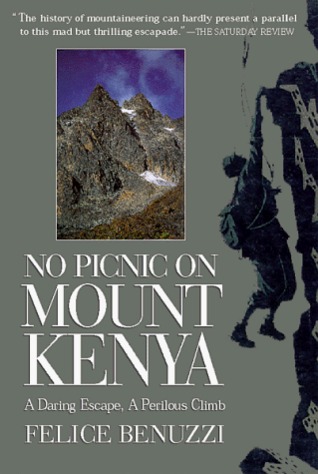
Book review: "No Picnic on Mount Kenya"

The story of "No Picnic on Mount Kenya" can be summarized pretty quickly. Three Italians, held as prisoners of war in Africa during World War II, escape their camp solely to try to climb the highest peak in Kenya. After the climb, they return to camp.

That simple summary, however, masks the details. And it is the details of this true story that bring it alive.

By 1943, Felice Benuzzi and his fellow Italians had been POWs of the British for some two years and they were bored out of their minds (true, if boredom is  your biggest problem as a prisoner of war, consider yourself lucky).

Benuzzi, who had climbed in the Alps before the war, cast his eyes on the distant Mount Kenya and its towering peak named Batian, and conjured up a crazy idea: Go climb it.

"Standing in the ranks at morning roll-call and seeing Batian beckoning me with its shimmering glaciers, I sometimes felt like running away on the spot, to seek and to meet adventure halfway," Benuzzi writes.

Recruiting two others to come with him wasn't easy because you can't exactly broadcast in a POW camp that you're planning to escape. Possible partners were scouted, secretive meetings arranged and whispered plans exchanged. The best-laid plans went awry. One partner was abruptly transferred to another camp shortly before the escape; Benuzzi had to scramble for  replacement.

Climbing equipment isn't exactly commonly available in a POW camp, so the men ingeniously made their own out of scraps of metal, strips of cloth, and random nails. Climbing guidebooks and Internet access weren't easily found either, so the prisoners had get bits and pieces of information about their intended climb from brief mentions in old magazines, and were delighted to find a simple drawing of the mountain on a tin of meat.

In the telling, Benuzzi maintains an understated sense of humor and an eye for detail. On the mountain he describes an approaching current of mist: "Fragments of cloud would reach the rock at our feet only burst and dissolve like a pricked soap bubble."

In all, the escape, climb and return took 18 days. They may be the only POWs in history to sneak back into a prison camp.

Benuzzi describes each step carefully you'll feel like you're along for the trip but for my money, he goes into more detail than is necessary. You may find, as I did, that you can skim through some parts.

Still, it is overall an enjoyable journey and well-told account. I'm glad they got bored.


---
 (Please support this blog by clicking on an ad, or by donating via the Paypal button below.)


Tuesday, January 6, 2015

Soccer tournament review: Mayors Cup in Long Beach

Compared to most youth soccer tournaments, the 2015 Mayors Cup in Long Beach, California, was relatively low-key.

While many tournaments are crammed with so many teams that shivering kids and parents have to show up at 7 a.m. Saturday to check in for 8 a.m. games, the first kickoff at the Mayors Cup was at the more reasonable hour of 9:00.

Other tournaments, pressed to fit everything in, shorten games and rush on the next set of teams the minute the final whistle blows for the previous match. Not the Mayors Cup. Games were full length (for the age group) and there was a comfortable 15 minutes between matches.

Also good: The Heartwell Park fields were not crammed together like at some competitions. There was ample elbow room.

Even parking was a bit less troublesome at the Mayors Cup than at most tournaments. You may not have been able to park exactly close to your field
in the world of soccer tournaments, that's as elusive as the lost island of Atlantis but there were enough spots within a reasonable distance.

Still, future participants should be warned: Be sure to read the parking signs. Some people who didn't got tickets.

The biggest weakness in the Mayors Cup (no apostrophe in the name; go figure) was the often unbalanced competition. As an "open" tournament, the Mayors Cup accepts all teams whether highly selective academy programs or a local recreational team and the differences showed.

One team pounded its opponents, 10-0, 9-1, 15-0, 7-0. There were other games that ended 12-0 and 10-0. One team was outscored by a cumulative 26-0.

Not all games were lopsided. Particularly at older ages, the competition was more balanced. Still, if you're entering this tournament be advised that you could be facing any level of opponent.

One last positive note: The reffing (that I saw, anyway) was pretty good. Did I disagree with a call or two? Sure. But generally the refs seemed to get it right.


---
 (Please support this blog by clicking on an ad, or by donating via the Paypal button below.)