If you're planning to visit Washington, D.C., as a tourist, here's a tip: Don't wear a belt.
If you wear a belt you'll be repeatedly taking it off and putting it back it on after passing through any one this city's omnipresent security checkpoints. It wouldn't hurt, of course, to get rid of that extra change you're carrying in your pockets and that submachine gun you commonly tuck in your waistband
Some of the security checkpoints, like at the Capitol or the National Archives, are quite understandable. But our family thought things had definitely gone too far when we faced a security checkpoint and an X-ray machine just to get into
– I am not making this up – a food court.
Though throngs of tourists come to the nation's capital every year, Washington is not very friendly to its visitors and the security checkpoints are just one illustration of that.
Consider Union Station. Thousands of people pass through this massive transportation hub every day, yet when we visited I could not find any information desk or other official person to ask where to catch the bus we were seeking. We tried asking other people but the guidance was so conflicting that we ending up painfully pulling our suitcases in 97-degree heat a couple blocks away before we found an appropriate bus stop.
And you'd think that a place like Union Station – which features a HUGE food court – would have plenty of well-marked bathrooms. Nope, they're pretty well hidden, and none of them are by the food court.
Then there's the Metro subway system. Metro has a fare structure that effectively charges out-of-towners an extra $1 a ticket. The best fares are reserved for those carrying a special farecard, but since the farecard itself costs $5 it's not worth it to buy one when you're just in town for a short time. So the one time we rode Metro we had to pay $3.10 per person rather than $2.10 – a 47% surcharge.
Now consider the wonderful National Mall. Visitors from around the world come here to see the many attractions, including the Smithsonian museums, the Capitol, Lincoln Memorial, Vietnam Memorial and the Washington Monument. You could say that this is the national gathering place.
Yet there's no easy way to get around the mall. It's a big area and only the most hardy would attempt to walk all around it (especially on those witheringly humid summer days). But there's no easy public transportation option to use here.
This would be an ideal place for a system of inexpensive shuttle buses that could circle the mall and pick up and drop off tourists as needed. Ironically, Washington has exactly this kind of system – the $1-a-ride DC Circulator – but those buses don't go anywhere near the mall. In fact, if you look at a route map, it appears as if the Circulator avoids the mall like it's radioactive.
At first, I thought this was just thoughtless planning. But then I recognized the real reason: There are commercial tour buses that charge $40 or so a person to cruise around DC tourist sites, and drop and pick people up along the way. A system like the DC Circulator that only charges $1 a ride would clearly be a threat. No doubt the Powers That Be have caved to the pressure, and deliberately keep the inexpensive system away from the Mall.
As we left the National Archives one day, a heavy rainstorm broke out. Unable to immediately find a cab, we retreated to an overhang at the exit of the National Archives, only to have a security guard scream at us that we couldn't stand there because we were blocking the exit. Except, even when we retreated to an alcove so we weren't blocking the exit, he kept screaming at us. Sigh.
Which brings us back to security. One day my family was hot, tired and hungry and ready for lunch so we headed to the Old Post Office Pavilion where there is a food court. At least I'm told there's a food court there, but we never saw it because there was big line caused by a security checkpoint, and we didn't feel like standing in the hot sun and waiting. Do we really need to be x-rayed to get a burger and fries?
---
(Please support this blog by clicking on an ad, or by donating via
the Paypal button below.)
Tuesday, September 25, 2012


Monday, September 17, 2012
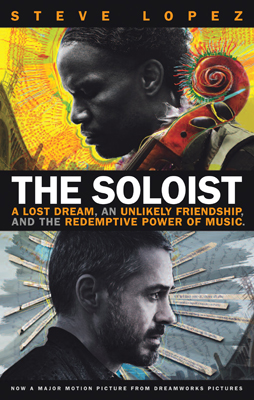
Book review: "The Soloist" by Steve Lopez
Los
Angeles Times columnist Steve Lopez was just looking for something he could write about when he stopped on a downtown street corner to listen to a disheveled man
playing the violin – and playing it well.
That
encounter would lead to a relationship that would transform both men’s lives,
and help to shine a light on the world of the mentally ill homeless.
In
“The Soloist,” Lopez describes his long and often-turbulent relationship with
Nathaniel Ayers, a musician once considered so talented that he trained at
Julliard. As Lopez describes, Ayers’ great musical prospects evaporated when
mental illness led him to behave so erratically that he lost the support of
everyone close to him. Eventually, he ended up sleeping on a street in Los
Angeles, and playing beat-up instruments at a noisy intersection.
With
writing that is silky smooth, “The Soloist” is an enveloping read. Lopez puts a lot of his emotions into the
story, describing the frustrations of trying to get Ayers, gently, step by
step, into social programs that would help him. No step went smoothly, as Ayers
resisted even the slightest changes. His mood swings were sometimes explosive,
and more than once, Lopez felt close to giving up. Almost anyone else would have.
The
book is more than a story about Ayers. Lopez uses this one person to look at
how the homeless and the mentally ill are treated – or not treated – in this
country. While it’s sad to see how many
lives are cast aside without anyone caring, it is inspiring to read Lopez’s
description of a handful of people who are working against the odds to help
this long neglected group.
Friday, August 10, 2012
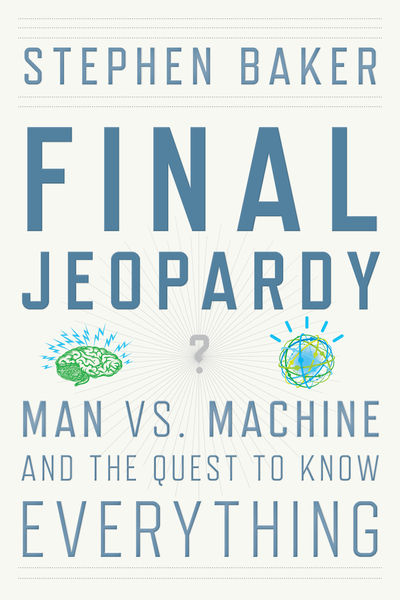
Book review: "Final Jeopardy" by Stephen Baker
Building a computer to play the TV game show "Jeopardy" seemed an impossible task to some when it was first proposed within the walls of IBM. How could a computer understand the nuances of the English language, decipher the sometimes tricky wording of a "Jeopardy" clue and then find exactly the right answer – all within just a couple seconds?
 Indeed, early in its training, the computer – known as Watson – was sometimes comically inept. One practice clue it faced was this: "A 2000 ad showing this pop sensation at ages 3 & 18
was the 200th 'got milk?' ad." The correct response was "Who is
Britney Spears?" But Watson chimed in with, "What is holy crap?"
Indeed, early in its training, the computer – known as Watson – was sometimes comically inept. One practice clue it faced was this: "A 2000 ad showing this pop sensation at ages 3 & 18
was the 200th 'got milk?' ad." The correct response was "Who is
Britney Spears?" But Watson chimed in with, "What is holy crap?"
But Watson got better – much better. In "Final Jeopardy," author Stephen Baker shows the years of work that went into building Watson and preparing it for a high-stakes match in 2011 against top "Jeopardy" human champions.
One thing that makes this book interesting is that it prompts you to think about thinking. When you're watching "Jeopardy," and you answer a clue correctly, have you ever wondered how you did it? How did your brain sift through the billions of possible answers in an instant and select the right response?
When IBM engineers set out to build Watson they had to think about this in detail, and recreate the mental processes that many of us take for granted.
Baker uses the examples of dogs:
"Deep down, computers don't know what dogs are. They cannot create 'dog' concepts. A two-year-old girl, in that sense, is far smarter. She can walk into that same kennel, see a Great Dane standing next to a toy poodle, and say, 'Doggies!" ... It's remarkably subtle, and she might be hard-pressed, even as she grows older, to explain exactly how she figured out that other animals, lke groundhogs or goats, didn't fit in the dog family."
To play "Jeopardy," Baker shows, IBM's team had to overcome several obstacles.
When faced with a clues, Watson first had to understand what the clue was looking for – was it a person's name, a place, a book title? It had to discern the key words in the clue that would lead it to the correct response. It then had to delve into its storage of facts and information (Watson was not searching the Internet) in milliseconds to come up with possible answers. And it had to understand game strategy and determine whether it had the confidence to respond.
The IBM team made hundreds, perhaps thousands, of adjustments to Watson. And in the end, it played "Jeopardy" very well.
I liked the book – I think most "Jeopardy" fans would – and Baker does very good job of laying out the steps and complications of IBM's project. Baker had a great deal of access to the IBM side, but I would have liked more from the Jeopardy side.
Also, it would have been nice to have some pictures of the many people profiled in the book.
Baker includes two chapters on artificial intelligence and while I understand why they're included, they go on a little too long.
In the end, Watson may have been far more of an engineering success than any kind of breakthrough in artificial intelligence. IBM designed it to do one thing – play "Jeopardy" – but it seems unlikely that the project will go down as major scientific step forward.
As an aside, for all the hoopla, I have to point out that "Watson" only mastered a modified version of "Jeopardy." Most "Jeopardy" games include some audio and visual clues, but as a concession to IBM, the show's makers agreed not to include those in the games Watson played.
-----
(Please support this blog by clicking on an ad.)
But Watson got better – much better. In "Final Jeopardy," author Stephen Baker shows the years of work that went into building Watson and preparing it for a high-stakes match in 2011 against top "Jeopardy" human champions.
One thing that makes this book interesting is that it prompts you to think about thinking. When you're watching "Jeopardy," and you answer a clue correctly, have you ever wondered how you did it? How did your brain sift through the billions of possible answers in an instant and select the right response?
When IBM engineers set out to build Watson they had to think about this in detail, and recreate the mental processes that many of us take for granted.
Baker uses the examples of dogs:
"Deep down, computers don't know what dogs are. They cannot create 'dog' concepts. A two-year-old girl, in that sense, is far smarter. She can walk into that same kennel, see a Great Dane standing next to a toy poodle, and say, 'Doggies!" ... It's remarkably subtle, and she might be hard-pressed, even as she grows older, to explain exactly how she figured out that other animals, lke groundhogs or goats, didn't fit in the dog family."
To play "Jeopardy," Baker shows, IBM's team had to overcome several obstacles.
When faced with a clues, Watson first had to understand what the clue was looking for – was it a person's name, a place, a book title? It had to discern the key words in the clue that would lead it to the correct response. It then had to delve into its storage of facts and information (Watson was not searching the Internet) in milliseconds to come up with possible answers. And it had to understand game strategy and determine whether it had the confidence to respond.
The IBM team made hundreds, perhaps thousands, of adjustments to Watson. And in the end, it played "Jeopardy" very well.
I liked the book – I think most "Jeopardy" fans would – and Baker does very good job of laying out the steps and complications of IBM's project. Baker had a great deal of access to the IBM side, but I would have liked more from the Jeopardy side.
Also, it would have been nice to have some pictures of the many people profiled in the book.
Baker includes two chapters on artificial intelligence and while I understand why they're included, they go on a little too long.
In the end, Watson may have been far more of an engineering success than any kind of breakthrough in artificial intelligence. IBM designed it to do one thing – play "Jeopardy" – but it seems unlikely that the project will go down as major scientific step forward.
As an aside, for all the hoopla, I have to point out that "Watson" only mastered a modified version of "Jeopardy." Most "Jeopardy" games include some audio and visual clues, but as a concession to IBM, the show's makers agreed not to include those in the games Watson played.
-----
(Please support this blog by clicking on an ad.)
Wednesday, August 8, 2012
The costs and rewards of visiting Gettysburg
If you come to Gettysburg to see the Civil War battlefield you may have a lot of questions. One of these could be, "Where the $%#@! is the visitor center?"
That, at least, was one of our first questions as we followed some oddly confusing directional signs that didn't lead very directly to the visitor center of Gettysburg National Military Park. We eventually did find the center, tucked well away in some woods, but it only prompted a new set of questions.
 |
| Options at the visitor center |
If you're expecting your usual National Park Service visitor center with a free museum and movie, you're going to be disappointed to find that almost everything here has a price. That's because, while the battlefield is owned and managed by the Park Service, the center is actually run by the Gettysburg Foundation.
Admission to see the movie, museum and a giant painting called the "cyclorama" is $12.50 for adults and $8.50 for kids (AAA discount is available). If you're well-versed in Civil War and Gettysburg history, you could skip this and go directly to the driving tour of the battlefield. But for most people, the movie and museum are good introductions.
The Morgan Freeman-narrated film is a decent overview of the battle, while the Cyclorama is a presentation of Pickett's Charge – the key moment of the battle – tied to an impressively huge 360-degree painting. The best part, though, is the museum, which gives a thorough accounting of not just the battle of Gettysburg, but the events that preceded and followed it. It has nice mix of static displays and videos.
 |
| The battlefield |
The next step is to take the driving tour of the battlefield (you can pay for a bus tour if you'd like). It was raining the day we visited, so that discouraged us from getting out of the car at many of the stops, but I always enjoy visiting the actual places where history happened.
I was struck by the size of the battlefield. It took us two hours to drive the tour route, and if you choose to stop more than we did, it could take twice that. You can appreciate how fighting could be taking place at one end of the battlefield without soldiers at the other end even being aware it was going on (apparently there was no Twitter).
Not every spot on the driving tour rang with meaning to me, but it was good to see the site of Pickett's Charge from both sides and to see why the height and position of the hill known as Little Round Top made the battle for it crucial.
How much of an impression did the visit make on my kids, ages 9 and 11? It's hard to say, but I was pleased to discover that the phrase "Pickett's Charge" had found it's way into my son's vocabulary as we talked later that day.
Friday, August 3, 2012
Review: Cleveland Rapid's Green Line
My son and I rode the Cleveland Rapid train system the other day to see baseball's Indians play. I had ridden the Rapid once before, but it was 14 years ago, so I felt like a newbie this time around.
The Indians did well – they won, 3-2 – but could still improve. The same could be said about the train system.
We caught the Green Line at, appropriately enough, Green Road station. There was ample, free parking – definitely a positive. A train, conveniently, was waiting. It wasn't immediately obvious how we were supposed to buy tickets, but as we boarded the driver told us to pay when we got to our destination, downtown Cleveland's Tower City.
I soon discerned that on inbound trains, those going toward downtown, you pay when you get off. For outbound trains, you pay as you get on. That's fine, but a sign saying so would make it easier for newcomers and keep the drivers from having to explain it.
The train was comfortable and ran smoothly, though a bit slowly, since it seemed to stop every three blocks along Shaker Avenue. About halfway into the ride, the driver told those of us going to the Indians' game (there were a couple dozen of us) to get off – the train we were on was going out of service. The driver told us to catch the next train, which was connecting in from the Blue Line. This seemed a bit odd, but the wait was short and we reached Tower City about 30-35 minutes from when we first got on.
We bought tickets here, though somewhat confusingly, they're not called tickets. Your choices are "farecards" and "passes." Ultimately, I bought a $5 "all day pass" for me and a similar $2.50 pass for my son (available for ages 6-12). The child's discount was nice – that's not offered on my usual transit system, Los Angeles Metro, where kids over 5 pay full fare. In all, the $7.50 was definitely cheaper than paying for parking at the ballpark.
From there, we just followed the Indians crowd through the Tower City center. There's a food court right there, which could be a good place to get something to eat and avoid the high prices at the ballpark. A short walk brought us to the game. Nice.
On the way home, though, I started to see a few more weakpoints in the Rapid. First, we had to wait a good 20 minutes for a train, and when it did come, it wasn't entirely clear it was the right train. While one end said "Green," the other said something different. There was no announcement or overhead sign indicating the train's destination. I had to ask another passenger to be sure.
It was dark on the way home and I found it almost impossible to tell where we were along the line. This was somewhat academic, since we were going to the end of the line anyway, but I wanted to judge how far we had to go. There were few announcements of stations, and even when there were, they were too soft or muddled to understand. Further, as we went through each station, it was nearly impossible to find a sign identifying the stop. Clearly, the Rapid needs to work on its communication skills.
Experienced riders, of course, don't worry about station announcements or signs. They know what train to get on and when to get off. But for newcomers, missing your stop, getting on the wrong train, or getting off in the wrong place are big fears. And if people are afraid of getting lost, they won't ride the train in the first place.
The Indians did well – they won, 3-2 – but could still improve. The same could be said about the train system.
We caught the Green Line at, appropriately enough, Green Road station. There was ample, free parking – definitely a positive. A train, conveniently, was waiting. It wasn't immediately obvious how we were supposed to buy tickets, but as we boarded the driver told us to pay when we got to our destination, downtown Cleveland's Tower City.
I soon discerned that on inbound trains, those going toward downtown, you pay when you get off. For outbound trains, you pay as you get on. That's fine, but a sign saying so would make it easier for newcomers and keep the drivers from having to explain it.
The train was comfortable and ran smoothly, though a bit slowly, since it seemed to stop every three blocks along Shaker Avenue. About halfway into the ride, the driver told those of us going to the Indians' game (there were a couple dozen of us) to get off – the train we were on was going out of service. The driver told us to catch the next train, which was connecting in from the Blue Line. This seemed a bit odd, but the wait was short and we reached Tower City about 30-35 minutes from when we first got on.
We bought tickets here, though somewhat confusingly, they're not called tickets. Your choices are "farecards" and "passes." Ultimately, I bought a $5 "all day pass" for me and a similar $2.50 pass for my son (available for ages 6-12). The child's discount was nice – that's not offered on my usual transit system, Los Angeles Metro, where kids over 5 pay full fare. In all, the $7.50 was definitely cheaper than paying for parking at the ballpark.
From there, we just followed the Indians crowd through the Tower City center. There's a food court right there, which could be a good place to get something to eat and avoid the high prices at the ballpark. A short walk brought us to the game. Nice.
On the way home, though, I started to see a few more weakpoints in the Rapid. First, we had to wait a good 20 minutes for a train, and when it did come, it wasn't entirely clear it was the right train. While one end said "Green," the other said something different. There was no announcement or overhead sign indicating the train's destination. I had to ask another passenger to be sure.
It was dark on the way home and I found it almost impossible to tell where we were along the line. This was somewhat academic, since we were going to the end of the line anyway, but I wanted to judge how far we had to go. There were few announcements of stations, and even when there were, they were too soft or muddled to understand. Further, as we went through each station, it was nearly impossible to find a sign identifying the stop. Clearly, the Rapid needs to work on its communication skills.
Experienced riders, of course, don't worry about station announcements or signs. They know what train to get on and when to get off. But for newcomers, missing your stop, getting on the wrong train, or getting off in the wrong place are big fears. And if people are afraid of getting lost, they won't ride the train in the first place.
The risks of pedicures, foot baths
Be careful when getting a
pedicure, says the California Department of Consumer Affairs.
- Foot spas that aren’t cleaned properly can harbor germs. “The screens and tubes of foot spas are particularly good places for bacteria to collect and grow, often forming dense layers of cells and proteins called biofilms, which can be very hard to remove,” the agency said.
- “Avoid any salon that is visibly dirty,” the agency advised. By law, dirty towels must be placed in a closed container and not used again until washed. Clean towels must be kept in a closed cabinet. Floors, walls and counters should appear clean.
- If you have an infection, don’t go to a salon. “Salons are prohibited from knowingly serving clients with communicable conditions such as the flu or strep throat.”
- Don’t go for a foot soak if you have bug bites, scratches or cuts. Don’t shave your legs for at least 24 hours beforehand. Diabetics are particularly at risk of infection when getting foot treatments.
- Foot basins must be cleaned between patrons. For whirlpool basins and air jet spas, the disinfectant must circulate for at least 10 minutes. Each cleaning must be recorded in a log; consumers have the right to inspect those books
- Nail clippers and cuticle tools must be cleaned and disinfected before use. Buffers, cotton pads and emery boards must be discarded after one use. Consider bringing your own cleaning tools.
(Please support this site by clicking on an ad.)
Friday, June 22, 2012
Book review: "The Man in the Rockefeller Suit"

This was the man many people knew as Clark Rockefeller, a con artist who cozied up to America's old money rich and became accepted as one of them through an audacious web of lies.
In "The Man in the Rockefeller Suit," Mark Seal tells the fascinating story of a man who changed identities as often as many people change jobs. It is, in Seal's words, a "10,000-piece puzzle" and if you're looking for a well-written page-turner, this is it.
The man who eventually became Clark Rockefeller began life in Germany as Christian Karl Gerhartsreiter. As a teenager, he came to the United States and soon adopted the first of many new identities. At the University of Wisconsin, he became Chris Gerhart, took a green-card wife, then disappeared.
In wealthy San Marino, California, he became Christopher Chichester, a young man who charmed the elderly matrons of the community while quietly putting his hand out for "loans." His craving to get his hands on the money of one alcoholic divorcee is linked to the disappearance of two people and a later charge of murder which is pending as of this writing.
In Greenwich, Conn., he became Christopher Crowe, a TV producer. In New York City, he passed himself off as a bond trader, and astonishingly rose to a vice president position largely through bluster and self-promotion.
Then, in his greatest transformation, he became a Rockefeller, part of one of America's most storied families ¬ and people bought it. He SEEMED to have money, and carried the aristocratic airs of wealth. Even his wife, for 12 years, did not doubt that her husband was Clark Rockefeller.
How did he do it? By all accounts, he was brilliant. Those who encountered him recalled his ability to talk on any subject, his mastery of trivia and computers. Moreover he played the role of wealthy aristocrat to perfection.
"He's talking to you as if he's smarter than you, more wealthy than you, more connected, more everything than you - no matter who you are," said one woman who was taken in by the imposter.
Seal leaves open the question of why the imposter did what he did. The obvious answer is that he did it for money, but there has to be more. He certainly enjoyed being the center of attention among the upper class. I believe he actually he got a thrill out of deceiving people. He seemed to relish telling ever more outlandish stories, almost as if he was testing how far he could go before someone would doubt him (surprisingly far, he discovered).
One of Clark Rockefeller's friends recalled, "At one point, some people were questioning his identity and being derogatory about it. I said, `Clark, I wouldn't pay that any mind. You are your last great story, your most recent trenchant analysis, the witticism you let float in the air. That's who you are.'"
Many of us are fascinated with these sort of stories in part because we wonder what it would be like to disappear and become someone else. What if we just shed our history and adopted a entirely new persona? This is impossible for most of us, but an intriguing thought nonetheless
And this story takes it to another level - not only did this man take on a new identity, he became "super-rich" with little or no money of his own. We wonder: How hard would it be?
------
(Please support this site by clicking on an ad.)
Subscribe to:
Posts (Atom)